
This is why I haven’t written a blog post in a while – sorry! Please don’t forget about me; I haven’t forgotten about you. Will be in touch soon xxx

This is why I haven’t written a blog post in a while – sorry! Please don’t forget about me; I haven’t forgotten about you. Will be in touch soon xxx

In our small group recently we were talking about idols of our culture – the things people around us live for. We split into groups of three and chose an idol per group to discuss. One group chose beauty, and they then shared their thoughts with the group. They talked about how the idol of beauty promises respect and acceptance, and how it requires your absolute devotion, and of course that it never delivers on its promises. It might be a surprise to you that it was three men who chose to discuss the idol of beauty. Not once did they refer to, or seemingly think about, the ways in which women seek after beauty. They were looking at the issue from a man’s perspective, and thinking about the men they knew who were slaves to the false god of skin-deep, body-building perfection.
Maybe I’m just slow, but when I read about teaching my children the truth about beauty, I tend to focus on my daughter and not my sons. I expect it will be a bigger issue for her, and maybe I’m right. But my sons need to know what true beauty is too. I can think of three reasons for this:
1. Recognising true beauty will help them worship God. God is the beautiful one – he defines beauty. So if my sons can enjoy true beauty, then they can gaze upon God and enjoy him. They will also see true beauty in God’s creation and give God the glory for it. But if their understanding of beauty is distorted, how can they truly enjoy and treasure God?
One thing I ask from the Lord,
this only do I seek:
that I may dwell in the house of the Lord
all the days of my life,
to gaze on the beauty of the Lord
and to seek him in his temple. Psalm 27:4
2. As I learnt from my brothers in our small group, the pressure to be ‘beautiful’ in the world’s terms are in no way reserved for women. As an example, Channel 4 recently made a documentary called ‘Extreme Male Beauty.’ They say, ‘With chiselled flesh and perfect grooming the norm, now it’s men feeling the pressure to look great.’ Perhaps my sons will have friends who are addicted to the gym. Perhaps they will have friends who all the girls fancy. Maybe they’ll see male models in adverts and magazines, or the tweezed and airbrushed actors in their favourite films and they might believe the lie. They might wonder if physical beauty will win them respect and will get them the girl. What a dangerous world they’re living in. I need to teach my son that his heart matters more than his haircut.
3. One day (soon!) my boys will be taking an interest in girls. I know, it’s a horrible thought. But if I teach my sons about true beauty now, I believe I am doing my future daughters-in-law a great favour. This might sound mean, but I do know some men who have clearly been raised well and who have great things to offer in a relationship, but who repeatedly choose women for their physical appearance rather than any inner beauty. I feel sorry for women whose sons have married less-than-lovely women who look good on their arm. I don’t want to be one of those women! For my son’s sakes, and for God’s glory, I want them to marry women who have the inner beauty of Proverbs 31: Charm is deceptive, and beauty is fleeting; but a woman who fears the Lord is to be praised (v 30).
If you’re wondering how I’m going to go about this, you are not alone. I might start by figuring out what true beauty is myself! I’m off to buy True Beauty by Carolyn Mahaney and Nicole Whitacre, and I’ll let you know how I get on…
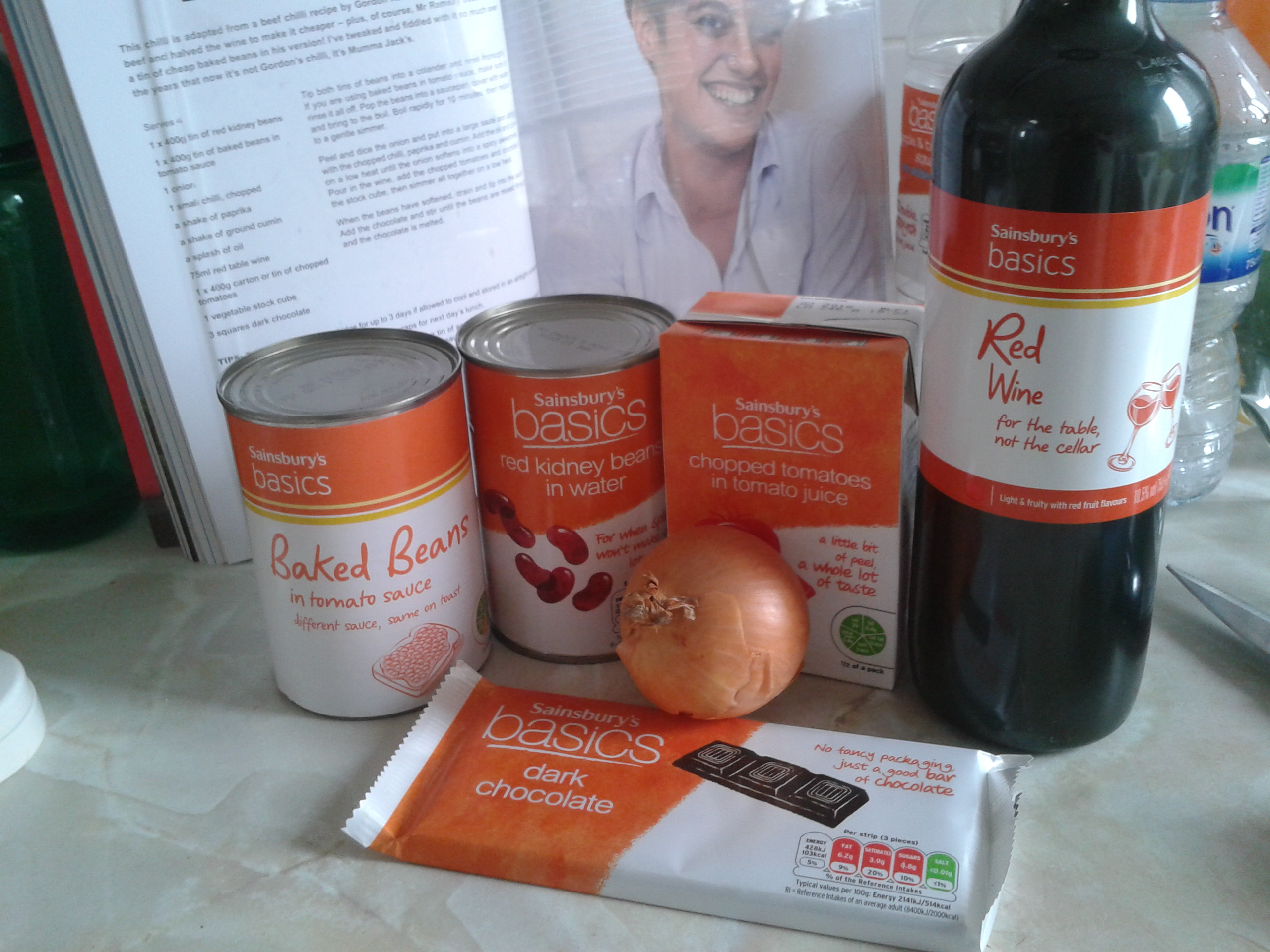
One lucky friend of mine came round for dinner recently – the dinner I made with the above ingredients. She enjoyed it! All thanks to Jack Monroe. If you would like to be able to afford to have people over for dinner but struggle (or just struggle with the food bill in general), hop on over to Good Reads to find out how A Girl Called Jack has helped me.

Last weekend was the first time since our baby was born (10 and a half months ago) that my husband and I have been away from the children for longer than a few hours. In fact we went away for a long weekend. We got the train up to Edinburgh, and along the way we threw our three children overboard into the arms of my parents, who took very good care of them for three days and three nights, woo hoo!
If you are married, I hope that you sometimes get chance to get away for a day or longer with your spouse. I know many parents who never even go out for the evening without their children – maybe you find yourself in that category. It might be that you’d love to have some alone time but you don’t have the opportunity – nobody to babysit being the biggest barrier I suppose. However I would like to encourage you to find a way of going out for the evening or longer, to spend some time with your spouse without your children. Five ways it helps us:
1. It helps us put us marriage first. In the busy-ness of life (the day-to-day blur of folding the washing and wiping things down and ‘Did you know it’s parents’ evening?’ and ‘Have you phoned the gas man?’ and ‘What does your mum want for her birthday?’ and ‘Whose turn is it to change the wriggly baby’s nappy?’) it’s easy to focus on the children to the point where they become the priority. This might seem loving at first, but what our kids need is for their parents to love and support each other. Biblically I should prioritise God, then my husband, and then my kids. So having a breather together, with no distractions, is great for our relationship, which is ultimately great for the children, too (good to remember that when feeling guilty for throwing them off a train).
2. It reminds me how lovely the children are. Taking a step back from looking after the children helps me to appreciate how precious they are and to remember their amazing qualities. I often get so bogged down in how hard work it is looking after them, that I forget what a blessing they are. Or I am just so busy doing the practical stuff that I don’t notice how fun they are to be with or how their characters are taking shape. Thinking and talking about them from a distance helps me to repent of this.
3. It reminds me that there’s a whole wide world out there, beyond the stretch of road between my flat and the school gate. My husband works in the real grown-up world, where people have exposable income, read the newspaper and talk about politics. I live in a world of pureed food, finger painting and Igglepiggle. And that’s OK, really, but for many reasons it’s good if I sometimes broaden my perspective. For one thing, it’s probably quite nice for my husband if I am a bit more aware of the world he’s living in. Also, one day my children will be older and it will help if I haven’t forgotten who the Prime Minister is or how to talk to someone who has never heard of baby-led weaning and doesn’t know a Bumbo from a Bugaboo.
4. It gives me time to read my book. Reading is good.
5. It helps me get perspective. We can have long chats about stuff we have been too tired/frazzled to talk about. We might even make some important decisions. Usually not, but it’s a start.
There are many more reasons to spend some time with your spouse, but I’m going to stop at five. I do think sometimes people can feel it’s very selfish to spend time without the children, so I just wanted to encourage you that it’s a really good thing to do. Everyone needs a holiday sometimes, not least mothers. And, in the words of Claire from Modern Family, when you go on a holiday with your children, ‘It’s not a vacation, it’s a business trip.’

I am excellent at feeling sorry for myself. I don’t need any help from anyone. I usually pile up any sympathy I’m given onto the wallowing-in-self-pity slagheap I have in my heart. My husband is good at pointing this out to me, thank the Lord. But even so, I am quite the martyr-complex extraordinaire. So if you’re anything like me, you might not enjoy what you’re about to read.
We had a ‘staycation’ recently. This is when you have a holiday at home, doing all the fun things you never usually get round to doing (aka ‘Kids, we can’t afford to go away, but there’s a nice park nearby we can go to….’). Thankfully we live in London, so there genuinely were lots of things to do. One day we went to see the Cutty Sark, which is an old British Tea Clipper (that’s a ship, folks) which has been restored so that you can visit it. Just a quick plug here: it’s actually brilliant. Please pay the ticket price and go aboard. Don’t just walk past and think you’ve seen it, that’s just silly. It’s non-profit, if that makes a difference to you.
Now of all the things to do in London, the Cutty Sark is not the most obvious choice if you’ve got three under-fives in tow. But the reason we went to see it is that my husband, Mr Clever, was one of the people who worked very hard for a long time restoring it and even, wonder of wonders, lifting it up into the air so that you can stand underneath it – behold:

So naturally, he wanted to show it to us. He didn’t get to give me the detailed tour he’d have liked to because of the aforementioned under-fives (who, incidentally, had a fantastic time), but it was lovely to see the results of his (and others’) hard work. One thing he enjoys about his job as a structural engineer is that when a project is finished, there’s something material and concrete (often in every sense) to look at and think, ‘I did that.’ Not out of pride, but just to have something to show for the toil. Even now he can’t refer to the ship as an ‘it,’ only a ‘she.’ This was his baby.
But as we were walking around and he was briefly explaining how they’d calculated the structural capacity of each bolt in the original iron frame, I realised something a bit sad. Even the people who love visiting the Cutty Sark will never really know how much work went into restoring it. The hours of calculating loads, of grappling over the budget vs. the integrity of the restoration, and the worrying about whether lifting the boat would really work (it’d never been done before, people!).
That’s life, isn’t it? In a fallen world, I doubt there is any job in which you always receive 100% satisfaction and appreciation for the work you put in:
‘Cursed is the ground because of you;
through painful toil you will eat food from it
all the days of your life…
By the sweat of your brow
you will eat your food
until you return to the ground…’ (Genesis 3: 17;19)
Some days, and some jobs, are worse than others in this respect. Sometimes you have nothing at all to show for a day’s work. Sometimes you don’t see the fruit of your labour in this life. And I think one reason we, as parents, often get sympathy (for which I’m thankful!), is that the sweat-of-your-brow element of parenting is pretty tough, and the results are hard to measure. Would my daughter look any different if I’d been a lazy, selfish mother these past four years? Maybe not at first glance. But really I know that, because of the efforts I’ve made, my children are different than they could have been. And God-willing, one day they will be all grown up and might even thank me! And if not them, then I know the Lord is watching me:
‘Whatever you do, work at it with all your heart, as working for the Lord, not for human masters, since you know that you will receive an inheritance from the Lord as a reward. It is the Lord Christ you are serving.’ Colossians 3:24.
This is true for all of us. We shouldn’t expect ultimate reward for our work in this life, but instead we’re waiting for our inheritance from the Lord.
So the next time I’m cleaning poo off the carpet, or enduring another tantrum, or getting up at 3am again, I can remember that one day God will acknowledge what I’ve done – and also that frustrations in work are not just the lot of the mum. My husband has them at the office too. He may be able to see the Cutty Sark in its glory, but people don’t see his sweat and tears in the wrought iron frame, and he even has to pay to get in (outrageous)!

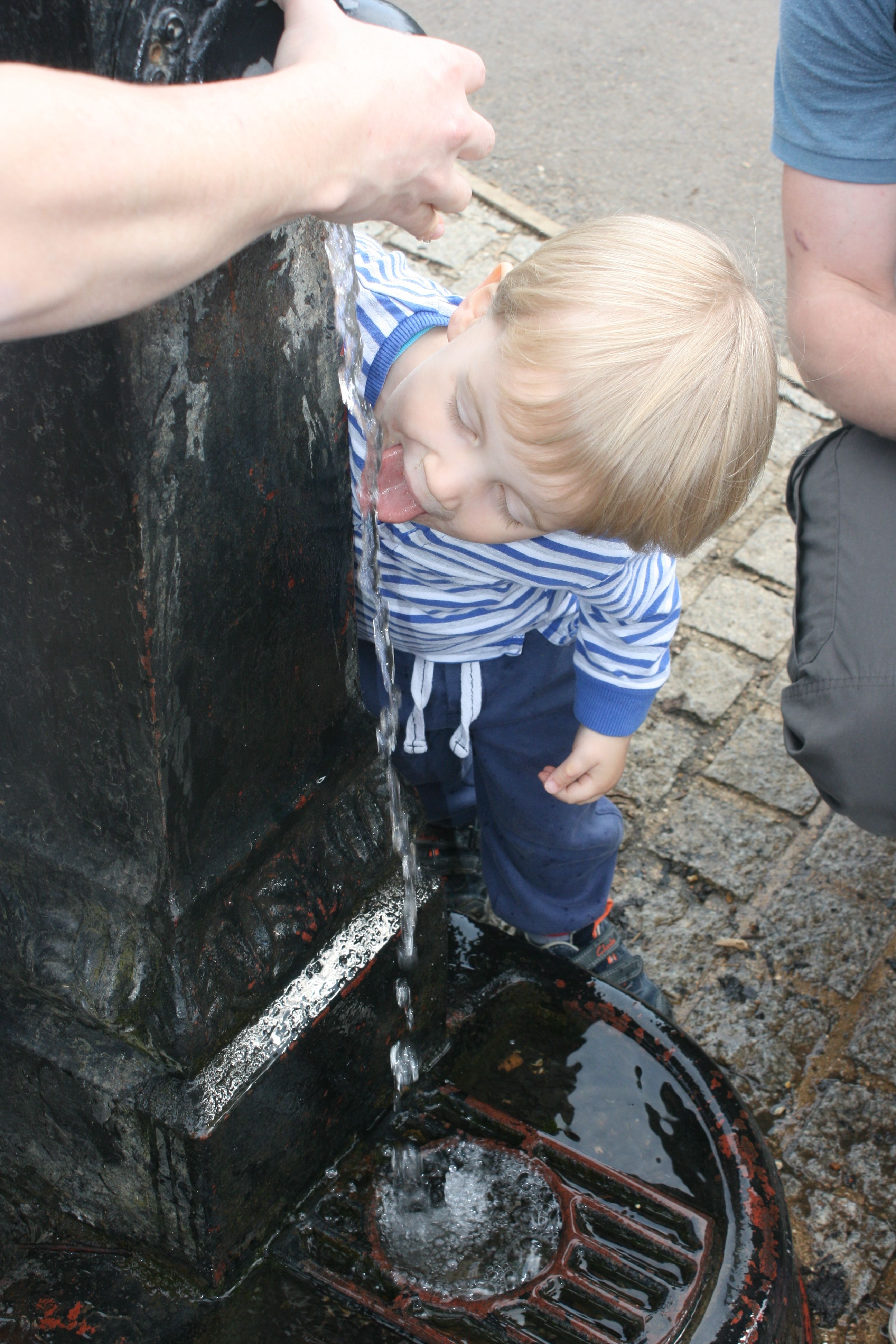
We just borrowed a book from the library (how good is the library?), Me and My Nan by Amana Rainger and Simone Abel. I’ve written the entire book below as a poem:
Nan came to meet me to take her to her flat.
I ran on to the bus stop. Nan said, “Don’t do that!”
We went to the shops, and Nan stopped for a chat.
I hid round the corner. Nan said, “Don’t do that!”
We walked by the river and I shouted, “There’s a rat!”
I thought it was funny. Nan said, “Don’t do that!”
I knocked on the front door with a rat-a-tat-tat!
Nan dropped all the shopping. She said, “Don’t do that!”
We had ham for tea, but I don’t like the fat.
So I hid it in the plant pot. Nan said, “Don’t do that!”
I dropped the ketchup. It landed, ker-splat!
Nan spilt her tea. She said, “Don’t do that!”
Nan watched the TV. I played with the cat.
He ran up the curtains. Nan said, “Don’t do that!”
I went to the bedroom, and tried on Nan’s hat.
It made me giggle. Nan said, “Don’t do that!”
I went into the garden, with my ball and my bat,
But I stood on the flowers. Nan said, “Don’t do that!”
So I got out my book, and I sat on the mat.
I tried to be good. Nan said, “Yes! Do that!”
Sorry it’s a bit long but I think that emphasises the point more. Do you wish that this Nan were your Nan? I know I don’t. But also as I read this book over and over again to my repetition-loving son, I wonder if I’m a bit like this. Do you ever get to the end of the day and feel like all you’ve said to your children is, ‘No!’ or ‘Don’t!’?
Even worse than being a mum like this Nan, is the uncomfortable notion that I actually think God is like this. I feel like the rest of the world is having a lot of fun, and I’m only allowed to do a few things, which are the grown up equivalent of ‘getting out my book, sitting on the mat and trying to be good.’ Just keep your head down and don’t do anything bad! If this is how I live, is it any wonder that my friends don’t find Christianity attractive? They don’t want to give up all the fun they’re having in order to worship a God who restricts their freedom. Of course, it’s not entirely my fault that they think that, but it’s good to wonder whether I’m reinforcing that idea by my attitude.
So is God like Nan? Not according to Genesis 2:
Now the Lord God had planted a garden in the east, in Eden; and there he put the man he had formed. The Lord God made all kinds of trees grow out of the ground—trees that were pleasing to the eye and good for food. In the middle of the garden were the tree of life and the tree of the knowledge of good and evil…
And the Lord God commanded the man, “You are free to eat from any tree in the garden; but you must not eat from the tree of the knowledge of good and evil, for when you eat from it you will certainly die.”
God made all kinds of trees – an abundance – that were pleasing to the eye and good for food (I underlined that in case you missed it). Beautiful and delicious and abundant. But there was a dangerous tree in the garden, and God warned Adam not to eat from it. So God is not a restrictive parent, but one who lavishes us with wonderful gifts, for our enjoyment and for his glory. The abundance of beauty we can enjoy gives us a glimpse of His generous, beautiful character.
But just like when the serpent uttered to Eve, “Did God really say, ‘You must not eat from any tree in the garden’?”, so Satan still lies to us now. I need to keep remembering that God is the opposite of this. He gives me freedom, and life in all its fullness. I am free to enjoy the life he’s given me:
The boundary lines have fallen for me in pleasant places;
surely I have a delightful inheritance. (Psalm 16:6)
Jesus answered, “Everyone who drinks this water will be thirsty again, but whoever drinks the water I give them will never thirst. Indeed, the water I give them will become in them a spring of water welling up to eternal life.” (John 4:13-14)
If my view of God is right, then I will pass this on to my children, both in my attitude towards God and in the way I interact with them. So often I find my default answer is ‘no’, and then afterwards I think, ‘Well, I suppose we could…’ I’m not saying we should give in to our children all the time or let them set the agenda, but I hope you can be encouraged to think about how to show our children that they are free to do anything but sin. Some children are forever trying to do things that will harm them (drink bleach/run into the road/chew electrical wires), and some children are like fountains of messy and energetic ideas (‘Let’s paint our bodies! Let’s make a chocolate castle!’ ‘Let’s do something with charcoal!’). So you have my sympathies. It’s a tricky business, this parenting. But I know that if I genuinely enjoy the freedom I have in Christ, then that’s an excellent start to teaching my kids about it. Now if you’ll excuse me, I must go and stop my baby eating stones again…

These are the lyrics to a brilliant and inspiring rap written by my friend Stephen (aka Carbon). There isn’t really a substitute for hearing it performed, but in the absence of a recording this will have to do. I hope you enjoy it anyway! Happy Easter.
Sunday morning, its gone dawn and
She’s upset, her tears are pouring;
She came out for the sake of mourning
And the whole of Jerusalem is talking
In a garden, with a tomb and a grave
where a man was buried and laid in
But, the body’s gone it’s moved –
a man standing there says “Why you weeping?”
Assuming he’s the gardener, she says
“Where’ve you put him? Did you move him?”
Now it’s the third day
Since he died and was taken away
He was crucified before their eyes,
hung on a cross and left to die,
Confused and they’re mystified
Is this God’s king that they call Christ?
What’s happening? What’s dawning?
This weren’t no normal morning
The One who died is walking
Risen from the dead he’s talking (x2)
This man he weren’t no gardener, tourist or random passer
It’s him that died and was laid
She knows it as he calls her name
Jesus Christ, he’s alive again
He walks and he talks – what can they say?
He’s up like a sunrise, a morning bright star
And he shows himself to his people after
Now this weren’t the ideas of a man
Or some carefully thought through plan
No, it was all part of God’s plan
He died so our sin wouldn’t stand
But we’re still guilty for all of our sin
We’re still responsible for the nails in his hands
And this is what Isaiah meant
Hundreds of years before this incident
A man being led like a lamb to the slaughter
Silent like a sheep stood before its shearers
What’s happening? What’s dawning?
This weren’t no normal morning
The One who died is walking
Risen from the dead he’s talking (x2)
Death couldn’t hold him
The grave couldn’t keep him
He rose from the dead like a man that was sleeping
Rose and visit your people when they were grieving
That’s like the sun blasting at ten in the evening
All they saw was this Lord of Glory
Dead but now breathing, talking and eating
To the degree that they thought they had seen a ghost
You said “Look at me! Touch my flesh and bones.”
So he died on the cross to deal with my sin
He’s alive and we are being made alive in him
Like a girl from the slums that got married into the royal family
You will raise us: share all life and live with him.
So death where is your sting?
Who can bring a charge against us? Who can say a thing?
It’s God that justifies, Jesus Christ who died
Who is raised to life, at the Father’s side.
And now we can reign in him forever
As we put our hope in this house that stands all weather.
What’s happening? What’s dawning?
This weren’t no normal morning
The One who died is walking
Risen from the dead he’s talking (x2)

‘Don’t trust anyone.’ You often hear that in films, and you can be sure that the main character will later be betrayed by someone that they do make the mistake of trusting. The implication of this is that you can’t actually live without trusting people. You might think you’re not a trusting person, but you still trust some people. If your children are at school, you trust their teachers to teach them and not to harm them. You trust the barista in Starbucks not to poison your coffee. And the higher the stakes, the more trustworthy a person needs to be. If you’re jumping out of a plane, you want your pilot and whoever packed your parachute to be trained and qualified!
I’ve put my ultimate trust in one man – not just for my life, but for the lives of my children. That man is the God-man, Jesus of Nazareth. I am bringing my children up to put their trust in him, and to do that I have to be sure I trust him myself. Otherwise, it’s too great a risk.
I got some good practice at this just under two years ago, when my brother had to have brain surgery to remove a benign tumour. My brother believes in Jesus, and so Jesus promises that my brother will have eternal life with him. Faced with the idea that my brother could die (brain surgery is brain surgery, after all), I had to decide again: do I trust this Jesus? Do I trust him with my brother’s life? At that time, I clung to this promise of Jesus from John’s Gospel:
‘I am the resurrection and the life. The one who believes in me will live, even though they die; and whoever lives by believing in me will never die. Do you believe this?’ John 11:25 (He said this to Martha, whose brother had just died.)
At that time of fear and uncertainty, I chose to trust Jesus. And every day, as I teach my children the Bible and bring them up to be soldiers of Christ, I am choosing to trust Jesus. I’m trusting that he is all that he said he is when he walked the earth.
But how can I trust him? There’s no greater risk than risking your eternal future, and so how has Jesus earned my trust?
Let me show you:
On the first day of the week, very early in the morning, the women took the spices they had prepared and went to the tomb. They found the stone rolled away from the tomb, but when they entered, they did not find the body of the Lord Jesus. While they were wondering about this, suddenly two men in clothes that gleamed like lightning stood beside them. In their fright the women bowed down with their faces to the ground, but the men said to them, ‘Why do you look for the living among the dead? He is not here; he has risen! Remember how he told you, while he was still with you in Galilee: “The Son of Man must be delivered over to the hands of sinners, be crucified and on the third day be raised again.”’ Then they remembered his words. Luke 20:1-8.
Friends, the tomb was empty.
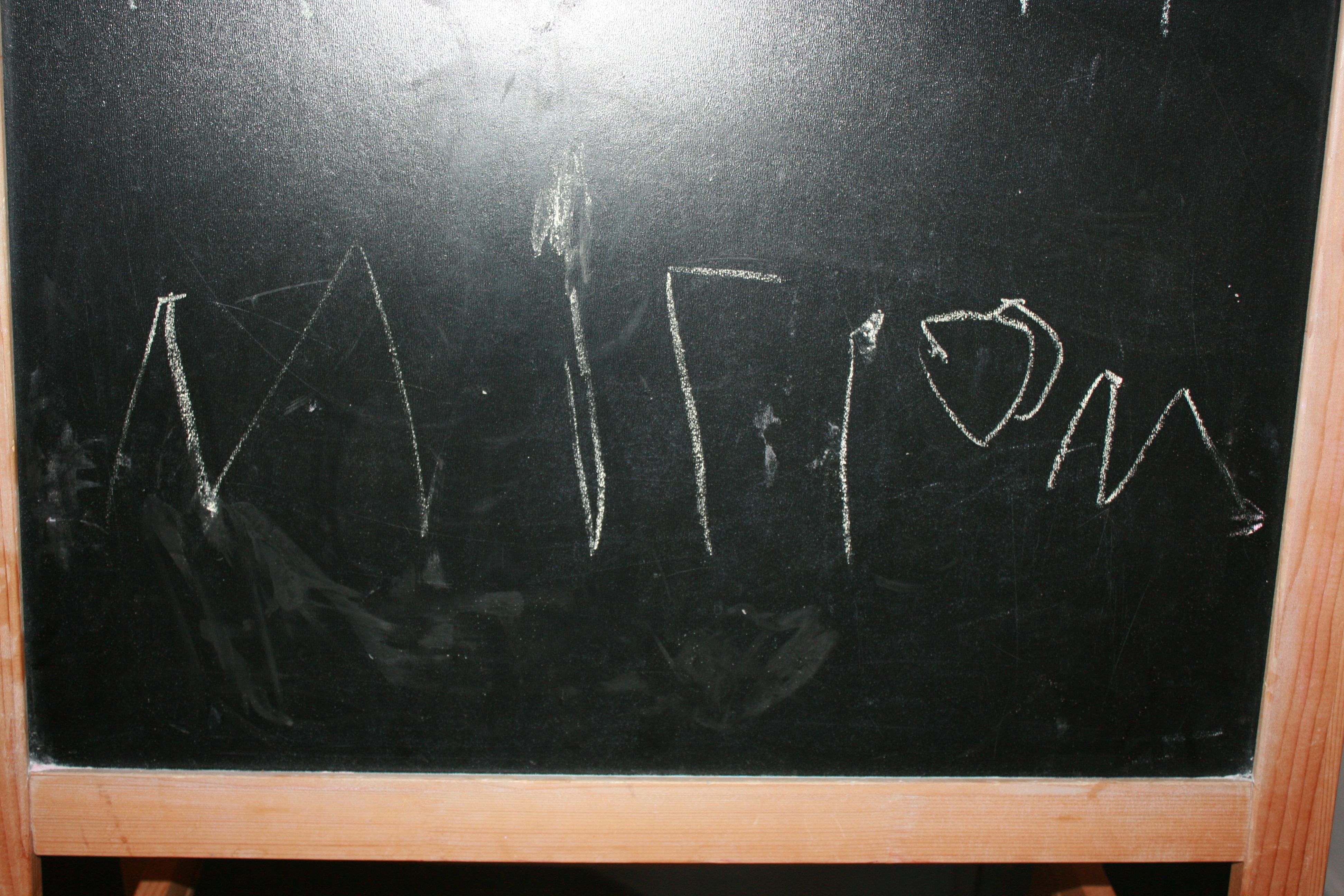
I’m reading through Jeremiah at the moment. Sigh. It’s so tragic, not to mention long. Recently at church we looked at Ezekiel together, and one thing I’ve learnt from Jeremiah and Ezekiel is this: the Lord hates idolatry. Sometimes I find myself turning to idols – comfort eating/retail therapy/thinking my husband can solve all of my problems – and I remind myself that those idols won’t satisfy me. They’re not good for me. And this is true – God uses it as a reason to turn from idols when he speaks to his people: ‘Where are the gods you made for yourselves? Let them come if they can save you when you are in trouble!’ Jeremiah 2:28.
But the first reason I shouldn’t worship idols is not actually to do with me and what I will or won’t get out of it. The first reason is that the LORD is the only true and living God, and he hates idolatry. He will not share his glory with another. Just read what he says to his people in Ezekiel 7v3-4:
The end is now upon you,
and I will unleash my anger against you.
I will judge you according to your conduct
and repay you for all your detestable practices.
I will not look on you with pity;
I will not spare you.
I will surely repay you for your conduct
and for the detestable practices among you.
It’s sobering stuff, isn’t it? Idolatry makes God angry, because he alone deserves all the glory:
But the Lord is the true God;
he is the living God, the eternal King.
When he is angry, the earth trembles;
the nations cannot endure his wrath…
He who is the Portion of Jacob is not like [idols],
for he is the Maker of all things… Jeremiah 10:10;16
So when I find myself trusting in other things, I need to repent and ask the Lord to give me a pure heart that worships him alone.
Sometimes, though, an idol is so ubiquitous and normal in our society that we might not even notice it. These are the dangerous ones, because if they’re even normal within the church, we’re much more likely to keep on trusting in them, and therefore not fully trusting in the Lord.
One example of a popular god in our society has caught my attention recently. This god is ruthless and cruel. It promises much: power, success, money, opportunity, legacy, freedom, but of course it cannot deliver. It will not satisfy. But also if you don’t live up to its high demands, this god will label you useless, stupid and an all-round failure. And even as its most devout followers begin to see the cracks and the disappointments in this religion, they are pushing their children harder in its rituals and practices. Perhaps they just need to work a little harder at it? Then they’ll really see results. They’ll have absolute security; they’ll be truly satisfied; they’ll really feel significant.
Have you guessed what it is yet? I hope so. This is the Western god of education, or perhaps I should say Academic Success. Now before you throw your laptop down in disgust (don’t do that, you’ll only regret it), I know that education and success in it are good things. For what it’s worth, I did extremely well academically at school and I know I’ve benefitted from that. But our society has turned this good thing into a false god, and the current generation of teenagers is being worked harder and put under more pressure than any generation before it. Youth groups suffer (i.e. discipleship takes a back seat) because teenagers can’t spare the time away from homework and revision. The local church ships its teenagers off to an independent school miles away while the school on its doorstep remains oblivious to the gospel message. Young people leave university, crippled with debt and still not knowing who they are or what to do with their lives. And all because we, not just our neighbours but our churches too, believe that salvation comes from being the top of the class.
Can I just reiterate that although I know I’m putting this strongly, I do believe that education itself is a good thing. If it adds weight to my argument, I did used to be a teacher and I loved it! And although I know this is a very contentious issue, I do believe we are free to send our children to whichever school seems right. I do also think that we need to examine and question our motives, particularly because the worship of Academic Success is all around us, inviting us in. Education might be a silver bullet, but it is not a saviour.
In a week’s time I will find out what school my daughter will be going to in September. Every year this gets in the newspapers, with headlines about ‘postcode lottery’ and parents almost having breakdowns with the stress of getting their kids into the ‘only good school in the area.’ As a mum, it’s really hard not to get swept along with the hysteria. Pangs of jealousy when you meet someone whose child got into the school yours didn’t get into. Lying in bed at night wondering whether she will be irrevocably damaged by a sub-standard primary school.
I could go on and on about this. If you know me personally, I’ve probably talked to you about it. Maybe I’ll write another post (or ten) about it in the future, but for now let me just encourage you that above all, your child needs Jesus. My daughter needs to know that the Lord made her – that’s who she is. The Lord loves her – that’s where her security lies. The Lord can forgive her sins – that’s her salvation.
The Lord loves your child, and his plans are perfect. This is true if you can afford the best prep school in the country; it’s true if your child has a scholarship to that prep school; it’s true if you home educate; it’s true if your child’s school is ‘bog standard.’ It’s true if your child’s school is the absolute worst performing primary school in the UK.
I love this from 1 Samuel: Do not turn away after useless idols. They can do you no good, nor can they rescue you, because they are useless (1 Samuel 12:21). In case we didn’t hear it the first time, he tells us again that the idols we make for ourselves are useless! Only the Lord is God.
So how do we do turn away from idols? As Tim Keller says in Counterfeit Gods, ‘idols must be displaced.’ We turn from idols by worshipping the Lord:
But blessed is the one who trusts in the Lord,
whose confidence is in him.
They will be like a tree planted by the water
that sends out its roots by the stream.
It does not fear when heat comes;
its leaves are always green.
It has no worries in a year of drought
and never fails to bear fruit.’ Jeremiah 17:7-8

What is church like? Recently in our Sunday service, we used some verses from Romans 12 to help us confess our sins:
Love must be sincere. Hate what is evil; cling to what is good. Be devoted to one another in love. Honour one another above yourselves. Never be lacking in zeal, but keep your spiritual fervour, serving the Lord. Be joyful in hope, patient in affliction, faithful in prayer. Share with the Lord’s people who are in need. Practise hospitality. (Romans 12: 9-13)
This is what God wants our church family to look like. So it seemed appropriate that we should use these verses to say sorry to God and repent of the ways we’re not like this at all. Two things stood out to me the most: verse 10, ‘Be devoted to one another in love. Honour one another above yourselves.’ Since becoming a mum, I’m sort of learning how to do this better inside my home. I am devoted to my children, and most of the time I think I do put their needs above my own. As parents we make sacrifices for our children – it’s part of the package. But a lot of the time, I’m so busy thinking about what my children are up to now and what shopping I need to get and I must remember to pick up that prescription and I need to remind Mike to fix that lamp and wow is that the time and I need a cuppa… that I don’t have the time or the capacity to look outside of my immediate family and see who else is out there. Or do I?
When I read that verse, can I just focus on the needs of my husband and children? Honouring them above myself is enough to be getting on with, surely? Well that brings me on to the other verse that stood out to me: verse 13, ‘Share with the Lord’s people who are in need. Practise hospitality.’ Is anyone in my church family in need? Of course. In fact, the more I get to know them the more I understand their needs.
God uses the church to bless us in so many ways, and I learnt a new one recently. As we carry each other’s burdens and share in each other’s sorrows, it sometimes helps to put our own problems into perspective. A friend in my church is trying to come off strong painkillers because they make her very tired, but as she began reducing her dose, the pain was too much so she had to revert to the high dose. She has to choose between pain and tiredness, and so she chooses tiredness. We are praying for healing for her, but in the meantime she is facing the possibility that she’ll have to take these drugs for the rest of her life. As I prayed for her and shared in her sorrows, I was humbled. I hate being tired – it gives me a knot in the pit of my stomach and I feel so sorry for myself. But why am I tired? It’s because I have three beautiful children, who are bloomin’ hard work all day and who often wake me up in the night. What a lovely reason to feel like a zombie! And one day I expect my children will stop waking me in the night and I’ll be trying to drag them out of bed in the morning, and I won’t have to change their nappies anymore, and they might even do a bit of cleaning and cooking for me. So as I thought about my friend’s predicament, it did make me thankful that my tiredness is probably temporary, and is a bi-product of the blessing of being a mother. However, if I hadn’t listened to her and prayed for her, I would never have realised any of this. I’d be feeling just as sorry for myself, and I wouldn’t be supporting my friend at all.
I hope you have a church family that is loving and supportive, I really do. Because if we’re all putting each other first, then nobody will be neglected:
Do nothing out of selfish ambition or vain conceit. Rather, in humility value others above yourselves, not looking to your own interests but each of you to the interests of the others. Philippians 2:3-4.
Imagine what church would look like if we really lived this out! If I could forget myself and look to others, then I would be imitating Christ. And what about my children? If all they see is me putting them first and ignoring everyone else, they’ll happily carry on thinking that the world revolves around them (an attitude they were born with). But how wonderful it would be if they saw their parents putting others first: if we said ‘no’ to certain treats so that we could give money to some friends who need it more; if we invited a lonely pensioner to join us on our family day out. This would show our children that we’re following a Saviour and Lord who didn’t look to his own needs, but who threw down his rights and looked up to Calgary.
Of course, sometimes we will feel like we’re so swamped that we can’t possibly listen to someone sharing their troubles, let alone help anybody. But here are two suggestions if that’s the case:
I need to focus more on how I can honour my church family, rather than all of the reasons I’m too busy/tired/preoccupied to do so. As a family, we (the Brookses) are in a great position to bless people in the church. For example, we could have someone round after church for lunch, since another mouth to feed probably won’t make much difference. Or I could siphon off some dinner and pop it round to an elderly lady’s flat so she doesn’t have to cook for herself tonight. We could commit to pray as a family each Monday morning for someone at church who’s lost their job. The kids could make cards to send to the church’s mission partners in Rwanda. I probably can’t do all of these things, but I can pray that God would give me opportunities and help me to rejoice in them. I don’t want to be self-centred and ungrateful; I want to lead my children on the path to self-forgetfulness and contentment.

