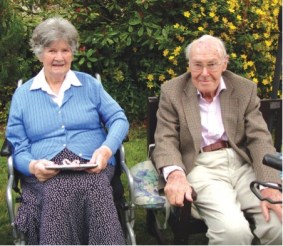
Amazingly, until December last year my husband had all four of his Grandparents still living. But his Nana went to be with Jesus in December, and in April her husband followed her. Gramps was almost 98 when he died, so while it was sad to say goodbye to him, we were able to celebrate his long and very interesting life together at a thanksgiving service in May. Aren’t people’s lives amazing? We found out that Gramps survived a direct hit on his flat during the Second World War, in which all of his neighbours were killed, and on a much lighter (but still amazing) note, he once had a cactus exhibition in the Chelsea Flower Show. He was an extraordinarily talented man. I wanted to share with you three lessons I learnt that day:
We pass on more than our hair colour
One thing I find fascinating is that while I sat there listening to the story of Gramps’ life, I could tell that my husband takes after him. Mike’s incredible focus and single-mindedness, his love for science and his creativity – all of these have trickled down, in part at least, from Gramps.
It’s worth bearing this in mind. I suppose I don’t have any control over some of the things I pass onto my children, but I can control some of it. Will I pass down a fiery temper, or patience? Will my grandchildren display my gratitude or my grumbling? Yikes. Something to pray about.
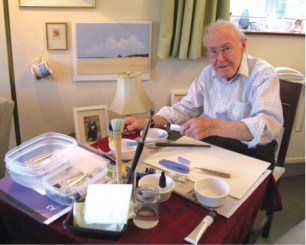
Gramps was also a very talented artist, and loved painting landscapes.
God’s creation speaks of his glory
Gramps spent almost his entire life resisting the Lordship of Jesus, but he was so impressed by the beauty of God’s creation that he couldn’t deny the existence of the creator God. He was, rightly, unceasingly amazed by the wonder of this beautiful universe.
I’m not really into plants, or animals for that matter. My children are more likely than I am to point out to me blossom on a tree or the bright moon on the afternoon school run. But I need to train myself to see the beauty in the created world. Since it all points us to the glorious Creator, it’s my duty as a parent to help my children enjoy the world and praise the God who made it all.
The heavens declare the glory of God; the skies proclaim the work of his hands. Psalm 19:1
It’s not too late to turn to Jesus
Gramps lived a life burdened with guilt over things he’d done. Being human, he’d done things to feel guilty about. And he found no relief from this burden until right near the end of his life here on earth. Without Jesus, we all have so much to feel guilty about, don’t we? It’s hard enough as a Christian, knowing I’m forgiven, not to dwell on awful or just downright foolish things I’ve said or done. And if we don’t feel guilty about things, we certainly will on the day we meet Jesus as our judge. That’s unless we’ve found forgiveness from the Father through Jesus the saviour. Gramps found that forgiveness through Jesus, and acceptance from God, right at the end of his life. The truth is, we don’t know when our life will end. So don’t put it off – bow the knee to Jesus today. In this life it’s never too late.
Jesus answered, ‘I am the way and the truth and the life. No one comes to the Father except through me. John 14:6.
‘Come to me, all you who are weary and burdened, and I will give you rest. Take my yoke upon you and learn from me, for I am gentle and humble in heart, and you will find rest for your souls.’ Matthew 11:28-29.
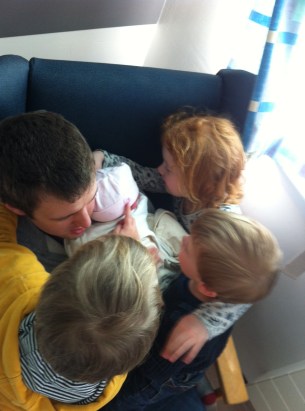
I had a baby. Her name is Martha. Martha Grace Brooks. She arrived on 7th April. (Why Martha?)
What a humbling experience it is to have a newborn baby. You hope you slightly know what you’re doing a bit more with number four, and maybe you do but still not nearly enough. And you also can’t predict what might happen with this specific baby. My baby got mastitis. No, I didn’t know that could happen either. Neither did the Receptionist at A&E. I had to argue my way in!
One day, around week two I think, my 6-year-old daughter asked me this: “Why are babies born as babies? Why aren’t they born, bigger, like one or six or something?”
I think the question behind that question is, “Why does it have to be so bloomin’ hard? So much crying from baby and mum, so little sleep, so many dirty nappies!”
What would you have said? I was caught off guard and in my semi-conscious state said something about it being good for us to be humbled as parents, and also that we don’t always know why God makes things the way he does, but he is wise and we are not. Not the best answer but I think it was at least true, so could have been worse.
But I’ve been thinking about it a bit more, and I suppose there are several reasons why the Lord created us to be babies first. And we know that he glorifies himself in creation: when we look at his world, it shows us what he is like (see for example, Romans 1:18-20). So what can I learn about the Lord from my newborn baby?
Well one thing I have learnt is that in some ways my relationship with my child is a picture of God the Father’s relationship with me, his adopted child. As I look at her in her vulnerable state, relying on me for everything, and really giving nothing back in return (she isn’t even smiling yet), I can remember that I’m in a similar position (although more extreme) before my Heavenly Father:
My heart is not proud, Lord, my eyes are not haughty; I do not concern myself with great matters or things too wonderful for me. But I have calmed and quieted myself, I am like a weaned child with its mother; like a weaned child I am content. Israel, put your hope in the Lord both now and forevermore. (Psalm 131)
As my baby trusts me, I can learn to trust my Father in heaven.
New parents often talk about the extreme emotions they feel for their newborn child, and how surprising it can seem that they are capable of such passionate feelings of love and protection for a little bundle of life. When I feel like that, I can remember that this is just a mere picture of the Lord’s feelings for his people. Look at how he spoke to his people through the prophet Isaiah:
As a mother comforts her child, so will I comfort you; and you will be comforted over Jerusalem.” Isaiah 66:13
The Lord in his mercy is using the picture of motherhood to explain to his people how tender his loving kindness is. And of course, his love is perfect, unlike the selfish, tired and grumpy version I offer to my own children.
I’m sure there are many more wonderful lessons about God which can be seen through nursing a newborn, but I am very tired and can’t go into them right now. If I go on any longer, I am bound to say something heretical by mistake. I also should be doing some housework and/or attending to my two year old, who is instead watching Bing.
So I will leave you once again with the words of that great Australian theologian of our time, Colin Buchanan:
“(One two buckle my shoe)
God loves her children like the chookie loves her chickies,
The mother hen will gather them underneath her wing.”
(See also Matthew 23:37 and Luke 13:34)
Please remember, sharing is caring, and if you’d like to comment please click on the speech bubble at the top.
‘Don’t trust anyone.’ You often hear that in films, and you can be sure that the main character will later be betrayed by someone that they do make the mistake of trusting. The implication of this is that you can’t actually live without trusting people. You might think you’re not a trusting person, but you still trust some people. If your children are at school, you trust their teachers to teach them and not to harm them. You trust the barista in Starbucks not to poison your coffee. And the higher the stakes, the more trustworthy a person needs to be. If you’re jumping out of a plane, you want your pilot and whoever packed your parachute to be trained and qualified!
I’ve put my ultimate trust in one man – not just for my life, but for the lives of my children. That man is the…
We don’t do time-outs with our children. I’m not saying you shouldn’t, just that we don’t.
My husband and I have agreed before that a time-out would be the worst kind of (reasonable) punishment for our six-year-old daughter. She would hate that more than anything. She can’t bear the thought of us being upset with her and not speaking to her. I know this because a) she finds it very hard to be alone, and b) if ever I’m quiet for a ten seconds after she’s done something wrong or annoying (either deliberately or not), she’s already badgering me to check I’m still speaking to her: ‘Mummy, Mummy I’m sorry Mummy!’
I know that a time-out is different from just sulking and not speaking to someone. And we don’t do either of those things with our children. Especially not the latter. Sometimes that’s hard. Like in moments like this:
Sometimes you think being quiet is the best course of action – sometimes it is. But if you’re actually punishing someone with the silent treatment, that’s not OK. The main reason that’s not OK, is that God our Father is not like that with us. As his children, trusting in Christ, we always have the ear of the Father. He always hears us, and always speaks to us. He’s never in a mood with us, he never makes us face the wall. He does, in love, discipline us, yes, but when we come humbly to him, ‘Daddy, Daddy I’m sorry,’ we’re never turned away.
I want my children to know what God is like, so that is one reason I don’t give them the silent treatment. But let me be clear – my children deserve the silent treatment from God, and so do I. I don’t want them to grow up thinking that God is always listening to them because they’re so lovely and good. I don’t want them thinking that God forgives their wrongs because that’s his job. Maybe that’s how you feel. That’s what the world around us tells us most of the time. If you believe that, please look more carefully at the cross of Christ.
You’ve seen pictures of Jesus on the cross – it’s ugly and agonising. But the real torture of the cross was not the physical suffering or the humiliating mockery. The real torture was that the Son cried out to his Father and got no response:
‘My God, my God, why have you forsaken me?’
For the first time in all eternity, the Father hid his face from the Son and didn’t answer. Jesus had been afraid to go to the cross because he knew that this would happen, and he knew that being cut off from the perfect, loving, life-giving God would be unbearable.
The only way for my children to have a perfect relationship with God the Father forever is for them to understand that they deserve no relationship at all.
But Jesus took what they deserve on the cross, standing in their place, so that if they believe in him they will never have to say the words, ‘My God, my God, why have you forsaken me?’ They will never hear Jesus say, ‘Away from me, I never knew you.’ (Matt 7:22) They will never have to spend eternity without him.
“[Jesus] got the Great Silence so we could know that God hears and answers.” (Timothy Keller, Prayer.)
If you don’t believe this – if instead you think that God is kind and good and will accept you, just as you are, then please take the time this Easter to check your facts. Have a read of a gospel, go to a Bible-teaching church and listen, meet up with a Christian friend. God doesn’t just pat you on the head and tell you that your sin doesn’t matter. The truth is much more wonderful, and much more costly (for him) than that.
Easter is a time of fantastic news, of Jesus beating death for us and winning us eternal life with God. I find thinking about the cross hard – I often want to skip Good Friday and move straight onto Easter Sunday. But the cross is really where I see how much God loves me. That he was willing to give his perfect Son the silent treatment I deserve, so that I can be his beloved child forever.
“19 Therefore, brothers and sisters, since we have confidence to enter the Most Holy Place by the blood of Jesus,20 by a new and living way opened for us through the curtain, that is, his body,…22 let us draw near to God with a sincere heart and with the full assurance that faith brings…” from Hebrews 10.
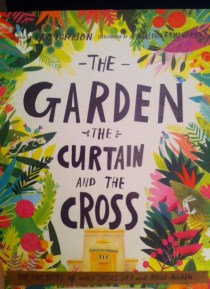
The controversial colouring page pictured above is a copy of a page from the book, ‘The Garden, the Curtain and the Cross‘ published by the Good Book Co., which you can read more about on my Good Reads page.
A while ago I recommended a book, The Garden, The Curtain & The Cross – you can read about it here. I’m going to use it this year to teach my children about Easter. In case you might find it helpful, here is what I plan to do. It’s not yet tried and tested, but I’ll let you know how it goes! I do hope it’s helpful. Again, I really recommend the book – much better than a load more chocolate for Easter – but if you don’t want to buy it I’m sure you could find corresponding stories in children’s Bibles if you wanted to.
Day 1: The Garden (Part 1) Read p. 1-6 (up to “It was wonderful to live with God.”) Main point:The Best thing about being in the garden was being with God, face to face.
Possible questions: What can we see in the garden?
Who made all of these things? (older children – What is God like (since he made everything)? – good, amazing, clever, kind, beautiful.) Who is in charge of all these things?
What was it like for Adam and Eve living in the garden?
What was the best thing about being in the garden?
Pray – praise God for making everything. Could look at Psalm 8 or 19
Songs: Who made the twinkling stars?
My God is so Big.
Craft ideas: Creation cookies (from Bake Through hte Bible – make biscuits shaped like different things God created and talk about the diversity of creation.)
Any baking/craft – talk about how we have made something so it belongs to us. Then share it with someone we love.
Day 2: The Garden (Part 2) Read p. 1-10 (Up to ‘God said, Because of your sin, you can’t come in.’) Main Point: The worst thing about sin is that it means we can’t be with God.
Possible questions: What was it like living in the garden with God?
What terrible thing did Adam and Eve do? They listened to the snake (this isn’t written in the book but I think it’s what my children will say.)
Why did they do it? They didn’t want God to be in charge.
When we decide we don’t want God to be in charge, what does God call that? Sin.
What happened to Adam and Eve next?
What was life like for people outside of God’s garden?
Pray – say sorry to God that we sin, we don’t treat him as the boss, and so we don’t deserve to be with him. (Thank him that we can pray to him because Jesus has rescued us from our sin.)
Craft ideas: Maybe a colouring page like page 9, with “KEEP OUT – Because of your sin you can’t come in” written on it? (Will have to recruit husband or creative friend for this task!)
Or maybe make snakes out of paper plates – write on them “Shove off God, I’m in charge, No to your rules.” (Although this is less linked to the theme of the book)
Day 3: The Curtain Read p. 1-14 (Up to ‘It is wonderful to live with him, but because of your sin, you can’t come in.’) Main Point: God comes to live with his people, but if they come face to face with God, they will die
Possible questions: What’s wonderful about the temple?
What is behind the curtain?
Why is the curtain there? (older children – It’s God’s kindness to put the curtain there so that the people don’t get destroyed by his holiness.) What pictures are on the temple curtain? (Reminds us of the Keep Out sign on page 9 that kept Adam and Eve out of Eden)
Pray: Thank God that even though we sin, he still wants to be with his people.
Song: “God is a holy God” by Emu.
Craft idea– make a big curtain out of craft paper/old wallpaper, with pictures of angels on it. (I’ll be drawing ours first and getting them to colour/paint it.)
Day 4: The Cross Read pages 1-24 (Up to ‘Because Jesus dies, we can go in!’) Main Point: By taking our sin on the cross, Jesus has made a way for us to be face to face with God again.
Possible questions: The Son had always been face to face with God in heaven, but he came to earth where things are sometimes sad and sometimes bad. Did Jesus ever sin?
Why did God’s son, Jesus, plan to die on the cross? (He took our sin)
And when Jesus took our sin from us on the cross, what happened to the curtain, God’s big Keep Out sign in the temple? (Tear the paper curtain we made. Maybe have a surprise treat on the other side?)
Pray: Thank God for sending Jesus to die even though he had never sinned, so that we can be face to face with God because our sin has been taken away from us.
Song: “God is a holy God” by Emu.
Craft idea: Although not a craft, the tearing of the “curtain” could substitute a craft. Or you could get them to think of things they do wrong/don’t do right and write them onto a cross, and then shred them/throw them in the bin to explain that Jesus took our sin from us on the cross. (NB! Please don’t let your children use a shredder without strict supervision! Maybe they could just watch you shred?)
Day 5: The New Garden Read the whole book. Main Point: Because the curtain tore in two when Jesus died for our sin, we can be with God face to face. We can know him now and will be with him forever in the new garden city.
Possible questions: After Jesus died, what happened to him?
Where does Jesus live now?
Who has Jesus invited to come and live with him in God’s wonderful place?
How has God’s ‘Keep Out’ sign been taken away?
What will be the best thing about living in God’s new heaven and new earth? (Being with God forever.)
Pray: Thank God for all the things we’ve learnt. Thank God that if we trust in Jesus we can be with him forever in the new heaven and new earth, where there will be nothing bad, and no one sad. Ask God to help us keep going, trusting him, until we get there.
Songs: “Easter Friday” by Emu.
“Home” by City Alight (my children love this one.)
“God is a holy God” – to recap on the week.
Craft: Make an Easter card with some words from the book:
We can live with God for ever! There will be nothing bad, and no one sad. It will be wonderful to live with him, And it’s all because of Jesus.
or a similar Bible verse, E.g. from Rev 21.3:
“Look! God now makes his home with the people. And God himself will be with them and be their God.”
It’s Mother’s Day here in the UK, which seems to be my cue to write something since I have a blog for mums and about mothering. I’ve been trying to write several posts lately, but being very pregnant (and thus exhausted) has been very much getting in the way. So this will be brief.
I’ve just started reading a book, Radiant – Fifty Remarkable Women in Church History by Richard M Hannula (Canon Press). As the title suggests, it contains stories of some very inspiring women, many of whom are mothers. I read this yesterday:
After the first few centuries of Christianity’s spread across the Roman world, the greatest growth in the church came from the nurture of children in her midst. As always, the day-to-day task of bringing children their first impressions of faith in Christ has fallen primarily to Christian mothers.
You might not feel like you’re doing anything very important, teaching your children about Jesus alongside teaching them to use their cutlery and not to spit at each other. Your friends might think you’re mad because you seem happy being ‘just a mum’ when you used to have a well-paid job. Or maybe you do know that bringing up your children to serve the Lord is a truly valuable calling – it’s still nice for someone to say it to you once in a while though isn’t it?
I have the heart of an evangelist, so I do sometimes get frustrated when I’m doing the third load of washing and doing the same jigsaw for the fifth time, rather than being “out there” sharing the gospel with friends and strangers. But when I read the quote above about Christian women living in the fourth century, I felt privileged that I could follow in their footsteps. Bringing up my children in the training and discipline of the Lord is part of church growth and will hopefully bless the church and many unbelievers in the future, when my children go out into the world.
I doubt I’ll ever feature in a book, and I suppose my children probably won’t either. There’s no reason to think that they will. But by God’s grace I hope that they might live fruitful lives serving their Lord and Saviour, and one day be welcomed into heaven. I will have the Lord and his abounding grace to thank for that, but I can also rejoice that he is using me for his purposes in their lives.
As a friend said to me on my last Birthday, I now say to you: I hope your family make you feel appreciated today – and if they don’t, your reward is waiting for you in heaven.
Is it church weekend away season? We’re signing up for ours now. I am looking forward to it – in the same way I’m looking forward to having a newborn (because I’ve forgotten all the pain and sleep deprivation and only remember the long term blessings). Incidentally, we’re hoping our newborn doesn’t actually GET born ON the weekend away.
So this post from last summer is now topical again – I hope it helps you to enjoy yourself (really!)…
I used to look forward to, and enjoy, weekends away with church. Now I brace myself for them, and often feel I’m the worst version of ‘me’ when I’m there. Sad, I know. But I believe that through prayer and practical wisdom this, the “time away with church family, with a family,” can be conquered!
I’m going away today, so I thought I’d offer some tips on how to get through, I mean enjoy, your time away (it’s more fun than packing). I’m in no way the expert, but I thought I’d share what I’ve come up with thus far – you’ll see I’m learning from my mistakes.
Things NOT to expect:
Sleep – Time and again I make the mistake of arriving on a conference/camp/ weekend away already tired, and hoping for some rest. Go on, point and laugh, I deserve it. You won’t get much sleep. Things will…
Click on Good Reads if you’d like to learn about a brilliant new children’s book about why Jesus died and rose again. The perfect Easter present, if you ask me. (Although I do like chocolate, folks, and I already have this book!)
One day I said to my daughter, “I’d rather you didn’t make that noise” and she said, “I would rather be a doorkeeper in the house of my God.”
She wasn’t being cheeky, I suppose she just hadn’t heard the phrase “I would rather” very often, so it reminded her of Psalm 84v11, which at that time we had unceremoniously stuck to the kitchen wall (I recommend this kitchen wall tactic, by the way. If your children can read, they will rebuke/encourage you several times a day!).
Better is one day in your courts than a thousand elsewhere; I would rather be a doorkeeper in the house of my God, than dwell in the tents of the wicked.
I suppose I’d put this on the wall to remind myself of something which I am prone to forget – that it really is better serving the Lord than living a godless life.
Sadly, Sunday mornings seem to be the time when I particularly forget this. This is the Sunday paradox. I know it’s not just me who feels spiritually attacked on a Sunday morning. I’ve heard other people say it, too. And it’s not that I think, ‘Aw, all my friends are having a lie in’ (like I would ever get a lie in anyway!), or that I wish I were watching my child playing football in the cold (!!), or that we were taking advantage of cheap Sunday morning cinema tickets (they do them on Saturdays too).
It’s on Sundays that bickering is worse than usual, that shoes get lost and lentils get spilled (and, joking aside, that is just the adults). It’s on Sundays that you wish you had taken it a bit easier on Saturday, and also been more organised (both excellent ideas, incidentally) since now you and your husband have three responsibilities each to take care of at the church gathering – which is nine altogether if we count our children (which I suppose we should).
I’m sure it’s not just my Sunday morning inner dialogue that tends to be a mixture of this sort of thing:
“As if I haven’t got enough to do!”
“Oh no! Visitors!”
“I need to stop being so selfish!”
“I think I’ve had the least sleep out of everyone here.”
“Where are my children?”
“Will anyone even notice I’ve done this?”
“Where is my husband?!”
“I haven’t heard a sermon in two months.”
“My family is doing more harm than good here!”
“I need to get over myself!”
Maybe this doesn’t ring any bells. But for me, I have a whiney selfish voice arguing with a more rational, godly voice quite frequently, and no more so than on Sundays. I love my church, I really do – I’ve told you that before. It’s me that has the problem.
Sometimes being a mum can feel a bit like being a “doorkeeper” – it’s not high profile, and you don’t need any qualifications to do it (which might give the illusion that it’s easy). And on a Sunday, maybe your role is to pin your children down while your husband does something more high profile. Or maybe it’s taking them out of the service so that people can actually hear what’s going on. Or maybe you’re leading crèche so that other mums can hear what’s going on. These things are unlikely to win you much recognition, and sometimes you might wonder why you even bother turning up. Or you might wish things were just a little bit less stressful, and that for once you could listen to a sermon all the way through and that nobody would throw up on you or wet themselves or have a tantrum.
So how can I remember that it’s better to do these (often thankless, mundane) things than dwell in the tents of the wicked on a Sunday morning? Well according to Psalm 84, I need to remind myself of how good the Lord is. I need to treasure Him above all else – above the world, above recognition, above my own ego. That’s why I like to sing the Matt Redman song based on this Psalm, because as we’re singing it we’re surely preaching it to ourselves, lest we forget:
How lovely is your dwelling place, Lord Almighty! My soul yearns, even faints, for the courts of the Lord; my heart and my flesh cry out for the living God. Even the sparrow has found a home, and the swallow a nest for herself, where she may have her young— a place near your altar, Lord Almighty, my King and my God. Blessed are those who dwell in your house; they are ever praising you.
When you’re a parent, you read a lot of picture books. You become picture book experts – not really a transferable skill, sadly. And these books can be enjoyed in their own right, and we can thank God for Julia Donaldson and those like her who can create such well-loved stories to share over and over (and over and over) again.
But I’ve also been thinking that if these stories (although fictional) contain any truth at all, then we can link that truth back to the one who is himself the Truth (John 14:6). (This is where I would insert a profound quote from the excellent book Lit! by Tony Reinke, if I hadn’t lent it to somebody. Sorry.)
To you this might seem a) completely mad and unnecessarily intense or b) blindingly obvious and patronising. If so, sorry. It is how my brain works and can, of course, be done in a not-intense way. If it is obvious, then I don’t mean to patronise you, and I apologise, but I’m not sure everyone’s brain does work this way so it might help some parents. If it’s helpful, I could do some more so let me know, esp. if your child’s favourite book is one you’re a bit stuck on, regarding gospel links! Hopefully it will give you a fresh take on the books you might be growing somewhat weary of, and give you a little teaching opportunity while you sit in the doctor’s waiting room etc.
Sorry these are almost all Julia Donaldson books. That’s mainly because we have the audio books in the car and have been driving a LOT lately (visiting family up and down the country). Which reminds me, Happy New Year!
Monkey Puzzle – Julia Donaldson and Axel Scheffler (JD & AS)
This is a good opportunity to talk about the variety of God’s creation. He could have made just a few types of animal, but he made millions, to show how amazing he is.
You could also talk about how the butterfly is a bit silly (metamorphosis complication notwithstanding) for not realising that the monkey’s mum would look like him, because we do look like our parents. Then you could talk about how, since God is our Father, we are (and should be) growing more and more like him (e.g. 1 John 3:1-3, printed below).
You could also point out that this is a good lesson in not wandering off in the supermarket, because you never know what kind of numpty will end up “helping” you find your mum!
A Squash and a Squeeze – JD & AS
The little old lady has a completely different attitude at the end of the book compared to the beginning, but nothing in her circumstances has changed – only her perspective on her circumstances. Often we grumble and grouse over things, whereas if we allow God to give us a new perspective we may find we become full of frolicks and fiddle-de-dees.
The most obvious application I can think of is that if we begin to give thanks for what we have (instead of focusing on what we don’t have), we will start to be truly thankful and rejoice. Often we might be praying for a bigger house/a better job/a nicer bike/more friends, when we could actually be thankful instead and in doing so become content and joyful over what we do have. I certainly want to live in a joyful, fiddle-de-dee house rather than a grumbling one, don’t you?
Room on the Broom – JD & AS
The lovely thing about this story is that the characters who’ve been rejected a bit by the world are welcomed onto the broom, and although they’re all different there is room for all of them. This is a nice little picture of God’s kingdom/the church. There’s always room for more people, for anyone who wants to enter, and it’s often those who’ve been rejected or let down by the world who want to be a part of it. The (important) difference between the church and the broom (!) is that we all enter through Christ, so we have a special connection unlike any other, which makes us family despite our differences.
Guess How much I love you – Sam McBratney & Anita Jeram
Although it’s very sweet that Big Nutbrown Hare tells his son that he loves him ‘right up to the moon and back,’ that doesn’t really mean a lot in reality. It’s not concrete, it’s just a nice thing to say. But our Heavenly Father proved his love for us once and for all by sacrificing his one and only Son for us when we didn’t deserve anything from him except judgement. We can be thankful that our Father does tell us he loves us in beautiful ways (E.g. ‘Keep me as the apple of your eye‘ Ps17:8), but he also proved it in a unique and most amazing way: This is how we know what love is: Jesus Christ laid down his life for us (1 John 3:16). And like Little Nutbrown Hare, any love we give in return is small in comparison, although still welcome. We can never outlove God. (Thanks to my husband Mike for pointing this out.)
The Smartest Giant in Town – JD & AS
The world usually thinks that the best people are the ‘smartest’ people. The best dressed, the best looking people. That’s what adverts want us to think. But it’s not what God thinks.
The animals in the story don’t care what George looks like: they care that he’s made an impact on their lives. He’s helped them, because he’s kind. It’s his character that matters most. (As my son said, ‘I like the bit where they say ‘the kindest giant in town.’)
And that’s what God thinks too: “The Lord does not look at the things people look at. People look at the outward appearance, but the Lord looks at the heart.” 1 Samuel 16:7.
Stick Man – JD & AS
On a Stick Man trail
Stick Man knows who he is, but nobody else (except his family) does. They think he’s a stick/a bat/a twig for a nest/an arm for a snowman etc., but he knows his true identity. He’s Stick Man, he’s Stick Man, he’s Stick Man, that’s him.
If we’re Christians, we’ve been given a new identity. We’re in Christ. We’re born again. We’re adopted. We’re holy. We’re new creations. We’re heirs. We’re treasured. But most people don’t see that, and they will call us other things. Again, 1 John 3 is helpful:
See what great love the Father has lavished on us, that we should be called children of God! And that is what we are! The reason the world does not know us is that it did not know him.Dear friends, now we are children of God, and what we will be has not yet been made known. But we know that when Christ appears, we shall be like him, for we shall see him as he is.All who have this hope in him purify themselves, just as he is pure. (v1-3)
So no matter how people label us, we can keep on remembering our true identity, just like Stick Man does. And we can keep living for the day when Jesus (not Santa, who is a big fat lie), will take us home, to the place where everyone knows who we really are. And we’ll stick right there, in the Family Tree, forever.
What the Ladybird heard – JD & Lydia Monks
This is the hardest one so far. I’m hoping you have stopped reading by now! But I couldn’t leave it out because it’s my 2-year-old’s favourite. i.e. I know it off by heart. It’s a tricky one. So much deception!
You could talk about God’s variety in creation again – how God has made all kinds of animals, with different noises to boot. How clever of him.
You could talk about how God has given Julia Donaldson an amazing gift for writing stories!
You could maybe talk about how sometimes it’s right to lie or deceive, if it’s protecting someone or something important (like Rahab, or when David pretends to be mad), but that would certainly be too much for my 2-year-old! Maybe my 6-year-old daughter would enjoy that discussion (which reminds me, I need to find out if Antarctica has been evangelised yet, because that was last night’s question from her).
But I suppose a big theme of this book is loyalty. Loyalty is a good one to talk to our children about. We should look after each other, especially those who are in danger. The Lord is always loyal/faithful to us, looking after us and defending us, and he is the protector of the weak:
Defend the weak and the fatherless;
uphold the cause of the poor and the oppressed.
Rescue the weak and the needy;
deliver them from the hand of the wicked. Ps 82:3-4
As I wrote above, do let me know if you’d like more of these.