Reasons to be Cheerful, Part 3

“It is for freedom that Christ has set us free. Stand firm, then, and do not let yourselves be burdened again by a yoke of slavery.” Galatians 5.1.

I don’t know if you’ve ever thought this, but I find it susprising that after reminding people that they are free, Paul’s instruction to them is to stand firm.  Not, “run around, then, and do a dance of freedom.”  Sometimes that is totally appropriate, of course, but Paul is writing to people who are being told that if they really want eternal life they need to be circumcised.  So in the face of that, the Galatian believers needed to stand firm in the freedom they’d been given in Christ.

As I wrote last week, I am so grateful for the likes of John Wycliffe and William Tyndale, who put God’s word into English so that common folk like me could read it for ourselves.  And the best thing about this is that it means we can know the true gospel, straight from God’s word.  I want to celebrate the Reformation with my children because if it weren’t for those brave men and women, many of whom gave their lives or their livelihoods, we would still be relying on priests and icons to tell us about God.

The Bible in my tongue means true freedom, the gospel of grace that has saved me from hell and brought me into a relationship with the Mighty God, my Heavenly Father.

“For it is by grace you have been saved, through faith – and this not from yourselves, it is the gift of God – not by works, so that no-one can boast.” Ephesians 2.8-9.

It is by grace, through faith in Christ, to God’s glory.

I don’t need to confess my sins to a priest, because Jesus is my Great High Priest. (1 Timothy 2.5).

I don’t need to do good works in order to be saved, because Jesus has done all the work for me. (See Ephesians 2.8-9 above.).

I don’t need to pray for the dead, because the Lord is just and will judge everyone fairly (Hebrews 9.27-28.), and Jesus paid the price in full for those who trust in him.

It’s not just that I don’t need to do these things, but that by doing them I take away from Christ, as if he didn’t do enough: “Christ died for sins once for all, the righteous for the unrighteous, to bring you to God.” 1 Peter 3.18

I can’t be saved by baptism, or pilgrimage, or charity, or taking communion – only by faith in Christ. (Romans 1.17 and Galatians 3.11 are just two examples.)

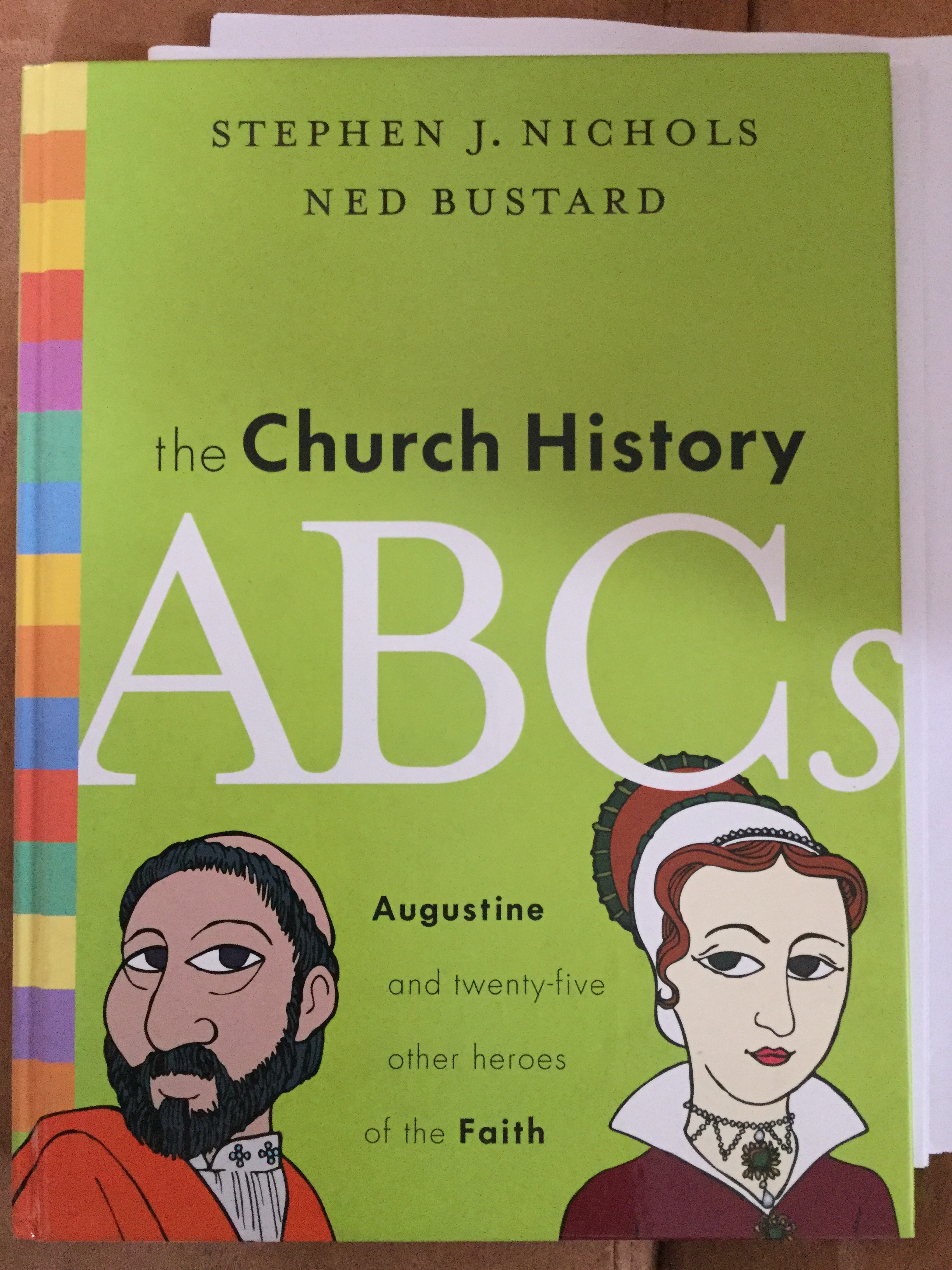
So in light of all that, I thought I’d let you know what we’ll be doing to celebrate.  I’m using the book pictured above, which – as the title suggests – has a different character from church history for each letter of the alphabet.  I’ve chosen six of these*, and between now and Monday we will look at one per day (we’ll just read their page from the book and thank God for them). We’ll do Luther last because I have a separate book about him (the little lights one) and it means we can dress up and pretend to nail something to the door, plus eat worm sweets and learn about his trial at Worms.
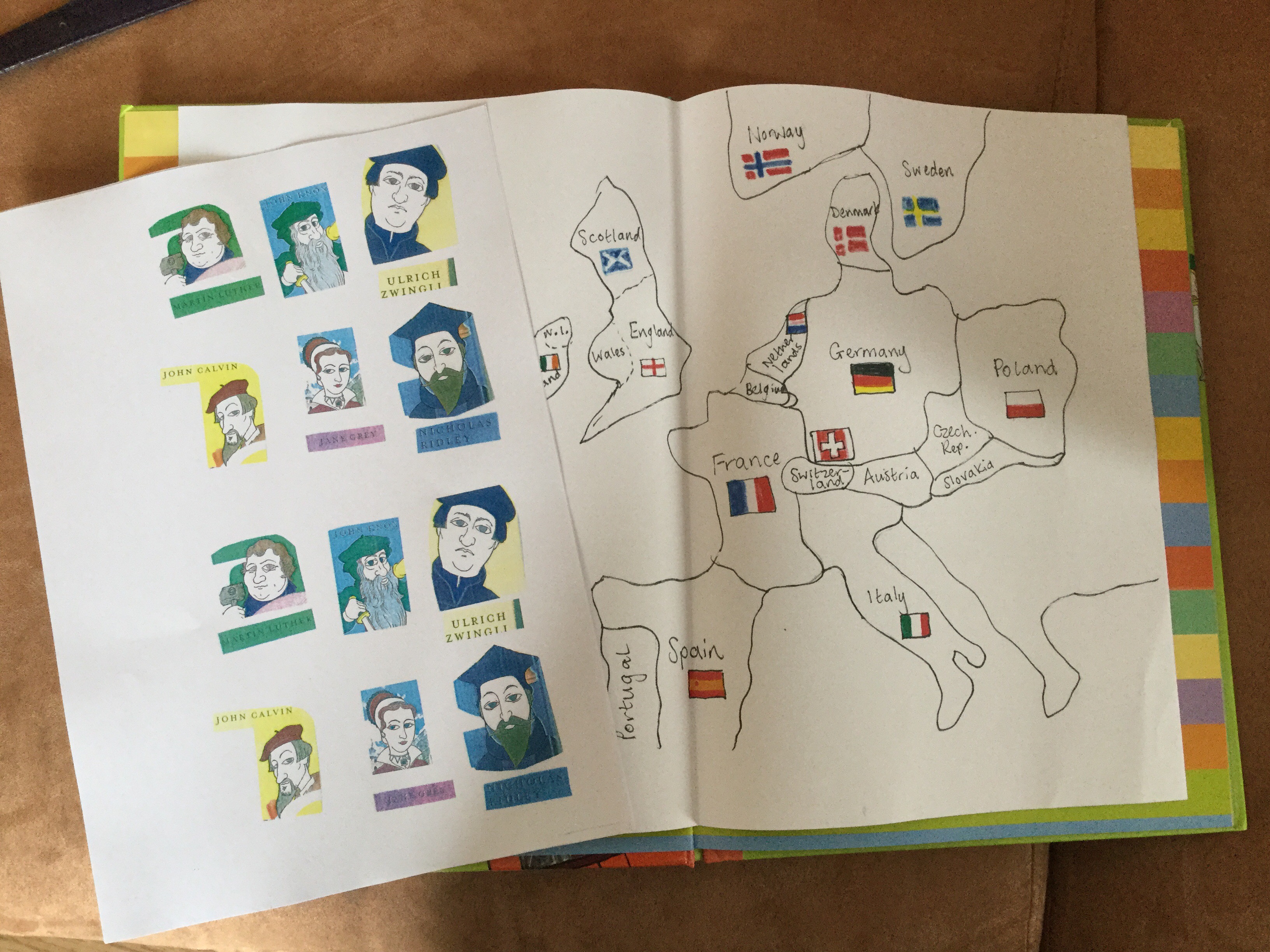

I drew a map (I’m not good at drawing but who cares really?), so that when we learn about a reformer we can cut out their head (so to speak) and stick it on the map.  This will hopefully make it more fun and help the children remember it.

At some point, probably Sunday or Monday (31st is officially Reformation Day), we will do this craft to help them learn the “five solas” which are five phrases that help to sum up the Reformation.  (I don’t think I’d heard of these before, thanks Rebecca Croft!). Here is a picture of the craft.  If only I were good with technology I could let you download it, but if you have a compass and protractor you could make it yourself.  A photocopier may help, depending on the size of your brood.  (I will see if I can upload it but am away now until Saturday so it may be too late by then, sorry.)
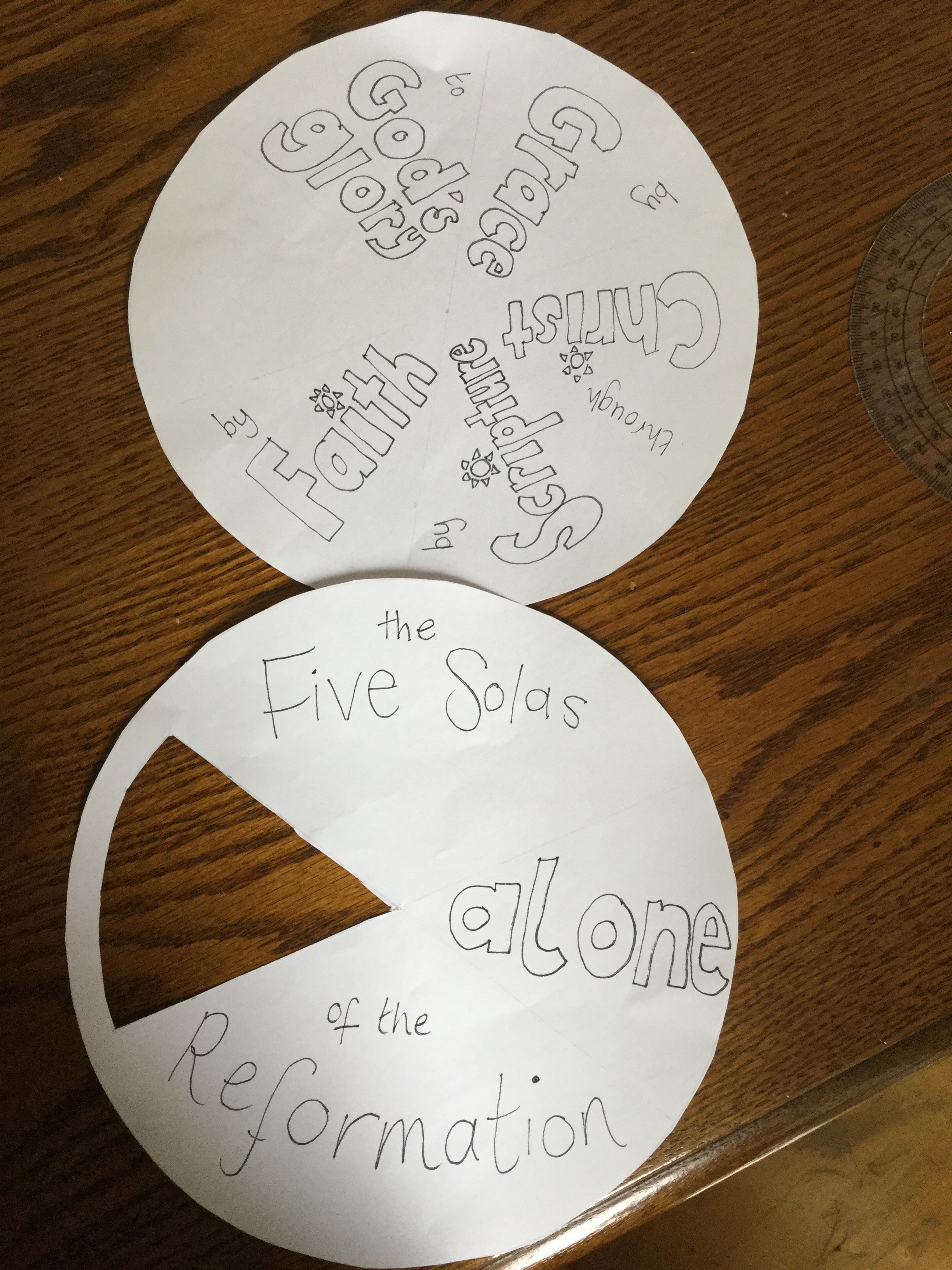

So the children will colour it in and then put one on top of the other, stick butterfly pin in the middle and hey presto:

Imagine it coloured in, with a butterfly pin, and not wonky.

So there you have it, I hope this is helpful and has inspired you to get excited about the Reformation (not just Ian Dury and the Blockheads).
*we’ll be looking at Lady Jane Gray, Zwingli, Ridley, Knox, Calvin and Luther.

Reasons to be Cheerful (about the Reformation): Part 2

IMG_0102.JPGI recently read a book called Radiant about “fifty remarkable women in church history.”  I realised reading this that many people have suffered greatly in the UK and Europe (as well as elsewhere of course) in order to reach people with the true gospel of grace.  Here is an extract from the chapter about Katharine Hamilton, the sister of James Hamilton.  They were Scottish aristocracy in the 16th Century.  James read the New Testament as well as some of the writings of Martin Luther, and began telling people about the forgiveness Jesus offers to sinners.  In this extract, James is explaining to his sister what he has learnt:

“But can it be that simple?” Katharine asked.  “All I need to do is trust in Jesus, and all my sins are forgiven and I inherit heaven?”
“As I have been showing you from Scripture,” Patrick said, lifting up his English New Testament, “we sinners can find peace with God only by believing in Christ.  He that lacks faith cannot please God.”
“But the priests and friars have always taught us,” she said, “that the way to heaven is through obedience to the church and good works.”
“Whoever believes or thinks that he can be saved by his own works,” he told her, “denies that Christ is his Saviour and that Christ died for him.  For how is He your Saviour if you can save yourself by your own works?”
“Are you saying that all my acts of penance and alms for the poor and pilgrimages to holy shrines – that none of that wins God’s favour?”
“Faith in Christ alone makes a sinner right with God,” he answered.  “Look to Jesus who did it all for you on the cross.  Forsake your trust in religious acts and come to Christ.”

If I were to underline the important bits, I’d have to underline the lot.  I’m so thankful that our gracious God allowed people, especially influential people, to unearth the true gospel and preach it to rich and poor alike.  Whoop, whoop!  If that ain’t worth baking a cake for, I don’t know what is.

Reasons to be Cheerful (about the Reformation): Part 1

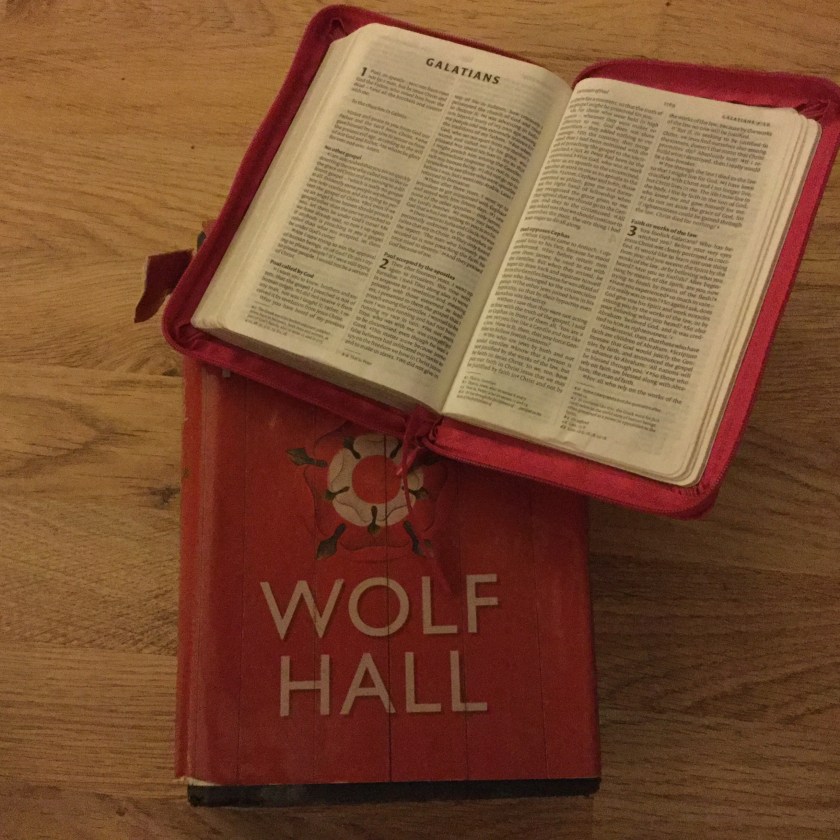
img_0101It might seem strange to celebrate a big bust up that has lasted centuries and led to much suffering.  I would love to explain to you why I think the Reformation is worth celebrating with my children.  First I’d like to let Hilary Mantel do some of the explaining on my behalf.  I don’t know if you have read or watched Wolf Hall.  I loved the book but the first episode of the TV series made me sob so I gave up, however I intend to try again at some point.

Here is a quote from the book about the difference it makes to have the Bible in your own language, compared to relying on church traditions and on priests telling you what to do:

There is an obdurate winter ahead.  But [Cromwell] feels a force ready to break, as spring breaks from the dead tree.  As the word of God spreads, the people’s eyes are opened to new truths.  Until now, like Helen Barre, they knew Noah and the Flood, but not St Paul.  They could count over the sorrows of our Blessed Mother, and say how the damned are carried down to Hell.  But they did not know the manifold miracles and sayings of Christ, nor the words and deeds of the apostles, simple men who, like the poor of London, pursued simple wordless trades.  The story is much bigger than they ever thought it was.  He says to his nephew Richard, you cannot tell people just part of the tale and then stop, or just tell them the parts you choose.  They have seen their religion painted on the walls of churches, or carved in stone, but now God’s pen is poised, and he is ready to write his words in the books of their hearts.

Since the Reformation in Europe, common people like me have been able to read the Bible for themselves in a language they understand.  We’ve been able to learn the whole story, not just the bits chosen for stained-glass windows.  Praise God.

True – Part Two

img_1854

Do you ever try to have a conversation with a friend while your children are present?  You start telling a story, and then you have to jump up to change someone’s pants or stop the baby chewing that wellie, or to break up a fight over a balloon, and an hour later you’re still only half way through.  I’m always impressed by parents’ determination to make it to the end of their story, come what may.  This level of perseverance is great training for something, I’m sure.

Well back in July I started to tell you something about Christian books for children, and then I got distracted by the school holidays, night feeds, reading a book about beauty, pureeing carrot, settling my child into nursery, inheriting a toddler group, cleaning up sick, that sort of thing, and here we are in October.  I never did finish what I was trying to say and now I feel it may be an anticlimax.  That’s the thing about the interruptions – they really pile the pressure on for the punchline of your story.

So really all I wanted to say was that children’s books do vary in their helpfulness.  I’m sometimes surprised by the choices people make, especially when they have so few words to play around with.  For example, we have a board book about the parable of the lost son.  It’s mostly a great book: colourful; clear; simple.  I like the fact it includes the older son, as sometimes children’s versions do omit important details (like the part where Jonah has a tantrum under a vine).  But look at this page – I’ll let you figure out which bit I wasn’t so keen on:

img_0099

This is a story about the Father’s heart for the lost.  Jesus said in Luke 15:20, that “while [the son] was still a long way off”, the Father ran to his son.  So why, oh why, did the good people who made this book, decide to write that he was nearly home?  Before I was saved by God’s astonishing grace, was I nearly with the Father?  No, I was still a long way off.

You might think I’m being pedantic.  Fair enough, you don’t need to analyse every board book you have.  But it’s good to have your eyes open.  We had quite an unhelpful book about the rich fool, which ended with, ‘this is why we should share.’ I can’t show you a picture of that because I binned it.  Children are so naturally legalistic*, I don’t want to feed that by strapping a moral lesson onto the end of a parable.  The rich fool teaches us to be rich towards God, which yes will no doubt end up in us sharing, but that’s not the main thing I want the children to take away from the story.

So, can I just encourage you to have a little read of a book before you buy it for your child or read it to them?  Someone recently gave us a book by Carine Mackenzie called Joseph’s Coat, which is incredibly concise so great for little ones.  (And it doesn’t end with, “so share your corn.”)  We’ve also got some lovely Susie Poole board books.  My favourite is Always Near Me, which is based on Psalm 139.  These would perhaps be good gifts for a toddler group or something.  I’ve just ordered a book about Christmas from Tenofthose.com which looks great but I can’t tell you about it properly because it hasn’t arrived yet.  (I ordered with it some books on Martin Luther so that we can celebrate Reformation Day on 31st October, but it turns out I’m not the only Tenofthose customer to have that bright idea, so they are waiting for more stock to come in.)

If I figure out what to do about Reformation Day, and I don’t get too distracted by space hopper incidents or butternut squash, I’ll tell you all about it.

Meanwhile, I would recommend the Beginner’s Bible (Good Book Co.), the Beginner’s Bible for toddlers, and the Jesus Storybook Bible.  We have the Beginner’s Bible bath book, which is the story of creation and is waterproof.  It’s also good for babies who like to chew books.  Hope this is helpful.  Any questions?

*By legalistic I mean that children love to be rewarded for good behaviour, and so they would like to be really good and have God love them for it.  When actually they are sinners in need of God’s grace and mercy.  (By the way, we grown-ups are like that too.)

Asked and Answered

I’ve been reminded of this lately, particularly when negotiating with my son regarding the number of plums it’s sensible to consume in one day. (You can rely on him to be harbouring a plum stone in his mouth most of the time.) I wanted to write a post tonight (not about plums or stones), but family had other plans. So I hope you enjoy this instead.

muminzoneone's avatarMum in Zone One

asked and answered

I’ve been watching The Good Wife – sorry to disappoint. If you’re blissfully ignorant, it’s a glamorous drama set in a Chicago law firm in which impossibly attractive people betray each other.

There’s a phrase that comes up a lot in the courtroom scenes: “Asked and answered.” It’s an objection which the lawyers use if their opposition is trying to emphasise a point by asking a question that’s already been answered, like this:

Lawyer 1:       “Who was with you in the car?”
Witness:         “The accused.”
Lawyer 1:       “So the accused was with you in the car?”

Lawyer 2:       “Objection, Your Honour! Asked and answered.”
Judge:            “Sustained.”

I said to Mike the other day that this “Asked and answered” objection is a phrase I’d quite like to use about a dozen times a day with my 5-year-old daughter. Conversations with her tend to…

View original post 490 more words

Rude not to

Hello there.  You probably already know about this but it would be rude of me not to mention that you can now buy the live album, See him Face to Face, by the co-mission music bods.  (Co-mission is a network of churches in London.) There are 13 songs on there, two of which were written by my gifted husband.  For about the first 12 weeks of Martha’s life, Mike was also working at editing these songs.  Why such bad timing?  Only the Lord knows.  But one day I shall see him face to face and can ask him.  Of course I won’t care by then.  I can hardly remember it now.

What was I saying?

Oh yes.  I highly recommend, but of course I’m biased so you should listen for yourself.  It’s on Spotify (although… adverts 👎🏼), or you can buy it here.

Sorry for the lack of picture.  We don’t have our copy yet…

Bringing Beauty Back

beauty
Captured by my son

The Mahaney family are experts at writing short, readable and practical books that pack a punch.  I recommend True Beauty to you, which despite fulfilling all the Mahaney criteria took me four months to read (well, just over two years if you count from when I blogged that I was going to read it.)  But hey, I had a baby.

I don’t really need to take what I learnt and package into a parenting article because there is actually an appendix in the book in which they apply the lessons to parenting.  So please do read the book.  However, here are some thoughts from me.  I’m afraid they’re a bit jumbled up, for which I partly blame the school holidays.

I don’t know about you but the issue of beauty seems to me like a bit of a minefield.  I don’t want my daughter to be vain, but I want her to know that she is beautiful.  And is it alright to tell my son he is handsome?  And how can I encourage the boys to value true beauty and not just long lashes and Disney manes?

We’re so bombarded with the world’s idea of beauty, however ugly that may be in God’s sight, that it’s tempting to avoid the topic of “beauty” altogether.  But if I do that, then my children will only have the world teaching them what is beautiful. And if I try to shield them completely from that, they will either think that all beauty is wicked or they’ll crave worldly beauty like a child craves refined sugar.  I don’t want my daughter to spend all of her (potential) pocket money on lip gloss and teen fashion magazines because I never even let her have a mirror in her room.  So, how do I navigate all of this without anything blowing up in my face?

What I know in my head if not always in my heart is that true beauty comes from the Lord, because he is the Beautiful One, the source of all beauty and creator of everything beautiful.  He defines beauty, and he is right.  (You should have been there when I tried to explain this – although not in those words –  to my hairdresser… awkward!)

As with all of the good things in this world, beauty has become warped and corrupted so that our own view of beauty is spoilt.  But beauty is a good thing, from God, so rather than avoiding beauty we need to celebrate it.  We will spend eternity gazing upon the beauty of the Lord, so it must be worth thinking about now!

I really think my children are likely to pick up on and inherit my own attitude on this issue.  If I say “Beauty is on the inside” but don’t walk the talk, they won’t buy it.  If my husband tells me I look lovely and I say “No I don’t,” and if the only compliments I ever give people are about how they look, and if I spend huge amounts of time and money on my own appearance, then that’s a pretty powerful message to my children.

I think it would really help if I did promote true beauty in the way that I spoke to the children and acted in day-to-day life, rather than just focusing on the false versions of beauty we see every day.  I can point out when someone does something beautiful; I can admire true beauty in others.  I can talk to my children when we come across examples of worldly beauty which I don’t think the Lord would value, such as saucer-eyed ice princesses having tantrums to music (“the cold never bothered me anyway”).  But I can explain those things in a measured way, rather than just banning all things Frozen or Barbie – unless I really want to.

Comic aside:
Ezra: “What’s Barbie?”
Miriam: “It’s a doll, like Hannah got for Christmas.”
Ezra: “Ha ha, Sweeney Todd’s a barber.”
You can’t argue with that.

The Lord’s version of beauty is so much more wonderful and liberating than the world’s. In the world, beauty fades with age.  But in God’s kingdom, the beautiful person is wise, generous, hospitable, gentle, hardworking, and joyful.  We can grow in these things, so in the church we can look to the older men and women and admire their beauty, and aspire to be truly beautiful. And when we seek to be truly beautiful, we are seeking God’s glory, instead of seeking attention for ourselves, which is vanity.  How wonderful it would be if I could bring up my children to enjoy the beauty of the Lord, and so reflect his beauty to those around them.

postcard
Smudged but still beautiful

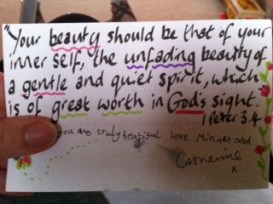
On a practical note, one way that my 6 year old daughter and I recently went on a “true beauty hunt” (I think that’s a quote from the book!) was to make postcards with Bible verses about beauty on them*, and then send them to some of the beautiful women we know.  This was a lovely thing to do because we enjoyed making the postcards look pretty(!), talking about the Bible verses and thinking about the women we were sending them to.  It encouraged the women who received them, but at the same time taught my daughter how to identify true beauty.  I’m praying for more ideas; please let me know if you have any!

*Such as Proverbs 31 v10 or v30; Romans 10v15.

If you have a comment, please click on the speech bubble at the top right corner of the blog post.
Please share on social media if you found this helpful, thanks!


Beautiful Sons

I first posted this over 2 years ago, and have finally gotten round to reading “True Beauty” which I mentioned at the bottom. Such, such slowness! But anyway, let’s not dwell on that (please!) – here’s a reminder of it before I let you know how I got on with the Mahaneys…

muminzoneone's avatarMum in Zone One

boys in blue

In our small group recently we were talking about idols of our culture – the things people around us live for. We split into groups of three and chose an idol per group to discuss. One group chose beauty, and they then shared their thoughts with the group. They talked about how the idol of beauty promises respect and acceptance, and how it requires your absolute devotion, and of course that it never delivers on its promises. It might be a surprise to you that it was three men who chose to discuss the idol of beauty. Not once did they refer to, or seemingly think about, the ways in which women seek after beauty. They were looking at the issue from a man’s perspective, and thinking about the men they knew who were slaves to the false god of skin-deep, body-building perfection.

Maybe I’m just slow, but when I read…

View original post 504 more words

P.S. (Unbreak your ball)

The day after I wrote “True” I found this masterpiece, written by my 5 year old son.

God rock

It’s the latest in a string of wonderfully misspelled creations by the comedy genius that is Ezra – his “ants go marching two by two” had me in stitches, I tell ya.

I don’t know if you’re familiar with the Colin Buchanan song God Rock, but it’s about standing firm on the Lord, our rock.  The words to the chorus are, “God Rock, get on board the God rock; unbreakable, unshakeable, God Rock.”  So while I’ve been hearing Ezra singing along to this and thinking how nice it is that he’s learning all about how God is our rock and all other ground is sinking sand, etc., well he actually hasn’t.

When I wrote before that some children are more spongey than others, I was thinking of Ezra.  He has an incredible ability to learn song lyrics.  The other day he taught me the order of the minor prophets without blinking.  I have Randall Goodgame to thank for that. But clearly even Ezra mishears the words sometimes.  And, like everyone else in the world, when he wasn’t sure he just guessed.  (Many of us then Google it but he’s thankfully not old enough to Google things yet.)  So this is just a reminder to all of us that it’s good to check every now and again that our children actually understand what they’re singing.  Especially when so often things are metaphorical.  I can feel myself going into another long post about this so will stop myself.

I just need to say, though, that we can’t do this every time.  A friend of mine with 3 under 4’s said to me one day that she’d love to teach her children the Bible more, but some days all she has the energy to do is to stick on a CD of Christian music.  She clearly felt that this was a failure on her part.  I looked at her and thought, ‘what a fantastic woman you are.’  If in your less wonderful moments all you can do is put on a Christian CD, then praise God.  I’m not saying that we all need to have a comprehension test after each song.  But just to have it on our radars that the children will sing along regardless of whether they have a clue what they’re singing.  Even if they get the words right, they might not know what “rejoice” “dwell” or “redeemer” actually mean… (signing off now, despite desperate desire to keep going!).

It would amuse me greatly if you could comment and let me know any funny mistakes your children (or you) have made with Christian song lyrics.

True – Part One

earplugs

A weird thing happened to me yesterday – two different people got  in touch with me to ask me to recommend Christian books for babies.  That’s never happened before, and it got me thinking.  It’s worth asking people for recommendations on children’s Christian books and music, because let’s face facts – there is quite a range available.  And by range, I mean some stuff is spot on, and some stuff is ambiguous, and some stuff isn’t good.

Does it matter? Let’s take music to start with.  I grew up in a family where we learnt the words to (secular) songs, and I find it impossible to consider a song without thinking about the words  (I’ve since learnt that this is not universal).  I’ve spent hours trying to figure out lyrics, listening with headphones (my mum was best at this) – and by the way hasn’t Google just taken the fun out of all of that?  But I digress.  So, I was raised to think that lyrics do matter.  Now I am married to a worship leader who chooses songs for our church to sing, and who also writes songs (in his spare time, ha ha ha ha HA!).  So he also thinks that song words matter.  If we’re singing to God to praise him and to encourage each other, shouldn’t we be singing stuff that’s true?  And by true I mean true.

So let’s honour our children by remembering it matters what they listen to and sing along to.  Children are sponges (some more than others, as I’ve discovered), and will quickly learn the words to songs even if they have no concept of what they mean.  So we should really be explaining things to them for a start, and also making sure we’re teaching them good stuff – dare I say it, sound doctrine.

earmuffs
Not quite ready for some music!

Here are two examples.  I don’t want to point fingers but I think it’s helpful to use examples.  Both of these songs are written by people who have written some great stuff, so I’m not saying anything about them as people, but I have comments about these specific songs.  Firstly, one from Hillsong kids:

It’s not a secret,
It’s not fairytale,
It’s not made up
,

Jonah was in the whale,
For three whole days,
123!

The greatest treasure,
The word God’s people wrote,
It’s in the bible,
Where Noah built a boat,
And it rained and rained,

The rainbow’s in the sky,
To show God’s promises are true,
The rainbow’s in the sky to show the world,
He’s the only way,
For your everyday.

OK.  Firstly, Jonah has very little to do with Noah or rainbows.  Why put him in the song?  It’s confusing.

Secondly, the rainbow is in the sky to remind us that God will remember his promise not to flood the whole earth again, which is quite specific:
1I have set my rainbow in the clouds, and it will be the sign of the covenant between me and the earth. 14 Whenever I bring clouds over the earth and the rainbow appears in the clouds, 15 I will remember my covenant between me and you and all living creatures of every kind. Never again will the waters become a flood to destroy all life. Genesis 9.
I suppose it does remind us that God’s faithful to that promise (and other promises), but I find the chorus a bit ambiguous.  I’m not pinning all of my hopes on God because of a rainbow, but rather because of the resurrection.

And thirdly, “he’s the only way, for your everyday” (not sure if you mean every day or everyday, but that’s a different issue*) – Jesus is the only way to the Father.  That’s a wonderful promise.  I feel like “for your every day” is quite a vague (and disappointing) ending to this sentence.  But OK, the song is about the rainbow (not John 14:6**), however the rainbow doesn’t really show me that God is the only way… does it?  If it does I can’t see how, and not sure my children will figure it out either.

So all in all, I wouldn’t ban my kids from listening to this but I would want to talk to them about it, and to be honest I would just put something else on which is clearer and doesn’t mix up Bible stories.  And again, Hillsong have written many good songs and I’m grateful to them and to God for that.  Please don’t take this as an attack on them.

My other example is shorter.  There’s a great CD called “Mr Cow” by Julia Plaut which has many good songs on it.  However, the ten commandments one has the refrain “these ten rules are all you need” (in fact, that’s the name of the song).  Well… if you mean they’re all you need except for the fact you can’t keep them and therefore you’re desperately lost and need a saviour, then yes I agree.  But since my children are naturally legalistic (being human and all), I don’t want to affirm that by letting them think that ten rules are all they need.  In contrast, Randall Goodgame’s Ten Commandments song is spot on:
“The ten commandments, no-one can keep them all,
The ten commandments, not even on our best behaviour…
The ten commandments, that’s why we need a saviour.” (from Sing the Bible 2).
I’d rather my children learnt this truth than that they actually learnt the ten commandments (which they will also do, from the song.)

So I hope I’m helping you to see that it really does matter what we teach our kids through music.  Maybe this was obvious already?  But when I’ve said stuff like this to friends they sometimes haven’t even thought about the words, so I hope it was worth mentioning.

Well I haven’t even got onto books yet.  Perhaps we should make this a two parter….

(To be continued)

*Don’t get me started on everyday and every day!  But I genuinely don’t know which they mean and that’s not their fault – I don’t have the official lyrics.

**Incidentally, if you want a good song about John 14:6 then Colin Buchanan’s is great (hoo cha hoo cha hoo cha cha).  Does anyone know a good one about rainbows?