Familiar with Pain

easter post 2015

It was mostly fear that had prevented me from reading this book sooner. Especially sensitive since becoming a mum, I didn’t think I’d have the nerve to get through a memoir of the holocaust. But I’m really glad I took the plunge, because never was an account of the Lord’s faithfulness more profound and strangely beautiful than The Hiding Place by Corrie Ten Boom.  This isn’t a book review, friends, but I am sharing one of the lessons Corrie taught me.

I started reading this book with hunger – a hunger to know that God is still good, even when the unthinkable happens.

Injustice is a legal term, and the legal system is not known for its shows of emotion. But I think injustice is, actually, extremely emotive. Often when I’m most upset, traumatised, furious, it’s because of injustice. Child abuse; exploitation; oppression. Someone, through no fault of their own, is suffering at the hands of others. Our hearts cry out against it, don’t they?

It can make us angry. Not just angry with the perpetrators, but with God, too. Doesn’t he see? Doesn’t he realise? How can he let this happen? Is he sleeping? I want to wake him up.

Here’s an excerpt from The Hiding Place. I’ve chosen one which doesn’t spoil the story for you. Here Corrie writes about the little Bible she had with her in Ravensbruck camp, and the routine medical examinations she, her sister Betsie and the other prisoners had to endure:

I had believed the Bible always, but reading it now had nothing to do with belief. It was simply a description of the way things were – of hell and heaven, of how men act and how God acts. I had read a thousand times the story of Jesus’ arrest – how soldiers had slapped Him, laughed at him, flogged him. Now such happenings had faces and voices.
Fridays – the recurrent humiliation of medical inspection. The hospital corridor in which we waited was unheated, and a fall chill had settled into the walls. Still we were forbidden even to wrap ourselves in our own arms, but had to maintain our erect, hands-at-sides position as we filed slowly past a phalanx of grinning guards. How there could have been any pleasure in the sight of these stick-thin legs and hunger-bloated stomachs I could not imagine. Surely there is no more wretched sight than the human body unloved and uncared for…
But it was one of these mornings while we were waiting, shivering, in the corridor, that yet another page in the Bible leapt into life for me.
He hung naked on the cross.
… I leaned toward Betsie, ahead of me in line. Her shoulder blades stood out sharp and thin beneath her blue-mottled skin.
“Betsie, they took His clothes too.”
Ahead of me I hear a little gasp. “Oh, Corrie. And I never thanked Him…” p.182-3.

Throughout the book, Corrie and Betsie find impossible contentment and even see beauty in the overwhelming ugliness of their situation. But if you widen your lens and absorb the bigger picture of her situation, your heart bursts with indignation at the injustice of it all. They’re called prisoners, but their “crime” had been protecting people from genocide. They’re people, made in God’s image, treated like vermin. None of this should ever have been allowed to happen.

But there is a greater injustice even than this. There was an ultimate injustice, and it happened in Jerusalem 2000 years ago, give or take. Not only had Jesus, God’s Son, committed no crime, he alone had committed no sin. He suffered injustice through man’s justice system, and died forgiving the ones who tortured and killed him. More than that, he died so that they could be forgiven:

“What shall I do, then, with the one you call the king of the Jews?” Pilate asked them.
“Crucify him!” they shouted.
“Why? What crime has he committed?” asked Pilate.
But they shouted all the louder, “Crucify him!”
Wanting to satisfy the crowd, Pilate… had Jesus flogged, and handed him over to be crucified. Mark 15: 12-15

You might be wondering – OK, but how does that help? I think it helps in many, many ways, but here are two (which I think, on reflection, are overlapping!):

There is the way it helped Corrie and Betsie in their situation. Jesus does see their suffering, and not just in a way that we see things on the news and know about them. He sees and knows, because he’s lived through it himself (“a man of suffering, and familiar with pain.”). Not just that, but he’s lived through worse. He suffered the ultimate isolation – being abandoned by God the Father – so that we don’t have to. So he can give great comfort in our time of need, because he’s been there. He’s actually been where we’ll never have to go: “My God, my God, why have you forsaken me?” (Mark 16:34). We’ll never have to, because he did.

And it also helps because of what he achieved for us. When we look at the cross, we see how much God cares about justice. He wanted to bring us into a world where there is only goodness and truth, where everything is fair, where there is no isolation and no grief. And there was only one way to make that possible, but it required sacrifice. Not ours, but His. So through suffering we can look ahead to that certain hope of a new creation where none of these questions will ever need to be asked again.

He was treated badly and made to suffer.
But he didn’t open his mouth…
He was given a grave with those who were evil.
But his body was buried in the tomb of a rich man.
He was killed even though he hadn’t harmed anyone.
And he had never lied to anyone.

The Lord says, “It was my plan to crush him
and cause him to suffer.
I made his life an offering to pay for sin.
But he will see all his children after him.
In fact, he will continue to live.
My plan will be brought about through him…

He was counted among those who had committed crimes.
He took the sins of many people on himself.
And he gave his life for those who had done what is wrong.”
From Isaiah 53 (NIRV)

Related links: Trust Issues; More than Sparrows; On your Knees

A Bloody Easter (you know… actually)

Ram craft

Hello all, it’s Easter soon!
I’d like to teach my children about the death and resurrection of Christ this Easter in light of the Old Testament substitutionary sacrifices (wow, big words).  So just in case it’s helpful, here are my notes.  I do plan to prepare some teaching for Good Friday and Easter Sunday too, but to give you a chance to use it I thought I’d post this now.
I hope to do these lessons next week, in the days leading up to Easter weekend.  Am praying it will help them to see why Jesus died and why it’s wonderful news for us that he’s our sacrificial Lamb.
Let me know if you have any questions about it.  Sorry about the formatting.  I tried my best!

Memory verse:  ‘For the wages of sin is death, but the gift of God is eternal life through Jesus Christ our Lord.’
(Colin Buchanan, Romans 6:23 from Remember the Lord or Seeds Family Worship ‘Hey Man’ from Seeds of Faith (available on their website)) I will spend time explaining what this verse means. (P.S. After doing the first session, I was somewhat discouraged the learn that my 3 year old thought we were singing ‘a tunnel life’ which would be much less exciting than eternal life.  Always good to check they understand what’s going on!)
I’m using the Jesus Storybook Bible, but I’m sure you could use another children’s Bible which include the relevant stories.

Bible story Questions/Discussion & Activity
The Present – JSB p. 62 (Abraham and Isaac) Remind them about Abraham, the promise and the son of the promise, Isaac.
Read the story.
1. How do you think Abraham felt at the beginning? (Sad! Confused!)
2. Did he have to kill his son? (No!)
When we sin, the punishment is death. Someone has to die for our sin. But in this story. Isaac didn’t have to die – what died instead of Isaac? (The ram)
3. BUT, Abraham had said God would provide a LAMB. So where is the lamb?
Jesus is the Lamb that God provided. Jesus died for our sin so we don’t have to. He died for Abraham’s sin and Isaac’s sin too.
We’ll find out more about that later in the week. Pray and sing the memory verse.Activity – Popcorn RamsUse picture of ram (I shall ask my husband to copy a basic one from a colouring page online) and write ‘The Lord will provide’ under it.
Stick popcorn to the ram’s body (optional! Could just colour it in).
And/or colouring page such as:

https://craftingthewordofgod.files.wordpress.com/2014/01/abraham-offers-isaac-coloring-page.pdf

God to the Rescue! – JSB P. 84 (The Plagues, Passover and Exodus) We learned last time about Abraham and his son Isaac. Isaac’s grandson was Joseph, and he and his brothers had loads of children so there were a lot of God’s people now. Let’s find out what happened to them.

Read the story.
1. God wanted to rescue his people from Egypt – but did Pharoah want to let them go?
2. God punished Pharoah and the Egyptians by sending lots of plagues – do you remember any of them?
3. The last plague was the worst – God said he would kill the firstborn son in every family.   But how could God’s people escape this punishment? (They had to kill a lamb instead and put its blood on their door frames.)
4. So if they killed a lamb and put the blood on the door frames, would they be safe from God’s punishment? (Yes!   And we saw them all get out of Egypt in the end, didn’t we?)
5. Yesterday we looked at how Isaac didn’t have to die – what animal died in his place? (A ram.)
6. In this story what animal dies in the place of the sons of God’s people?   (A lamb.)

Yes! Do you see that God provides something to die instead of his people. They deserve to be punished and die, BUT because they trust God and sacrifice an animal instead, God keeps them safe. Pray and sing memory verse.

Activity – Hand Lambs
Make lambs by drawing round their hand on black paper or card. The thumb becomes the head and the four fingers the legs. Stick/draw an eye on! Cotton wool for the body!
I recommend doing something with red paint so that the blood stays in their memory. (Nothing too graphic! My son was traumatised once by a Passover drama!)
Paint a pic of a door frame red (see link below) – you could pretend to cut up your lambs first – or have a pre-made sacrificial one to cut up!
http://www.biblekids.eu/anticotestamento/moses/moses_coloring_pages/moses-coloring-page-6.jpg

The Servant King – JSB p. 286.

The last supper

Do you remember how God rescued his people from Egypt? (Recap on the Passover)
God’s people would celebrate the Passover every year by having a meal together and telling the story. They would eat a lamb and remember how the lamb had died instead of God’s people.   In this story, Jesus celebrates the Passover with his disciples.Read story.
(Have props – bread and red juice – to talk them through this.)
1. What did Jesus say about the bread? (It is his body – it will break like the bread)
2. What did he say about the wine? (It’s like his blood – it will pour out)
3. Did Jesus know that he was about to be killed on the cross? (Yes!)Just as the Passover lamb died, now Jesus was going to die instead of the disciples. They wouldn’t have to kill a lamb and put the blood on their doors – Jesus would be their sacrifice instead.
We are like the disciples – we can be saved from death if we trust in the blood of Jesus.
Just like the ram was killed instead of Isaac.
Just like the lamb was killed instead of the sons in Egypt.
Jesus was killed on the cross, instead of you and me.
Pray and sing memory verse.

Activity – Sacrifice collage
Colouring page – Jesus and bread/wine such as
http://www.kidsplaycolor.com/jesus-raise-his-grail-in-the-last-supper-coloring-page/

On A3 paper (or two stuck together if you need them) stick their rams and their lambs and then draw arrows down to the picture Jesus with the bread and wine. Explain that Jesus is our sacrifice (write that underneath)

Boot Camp

photo

There once was a handsome, overlooked shepherd boy called David.

Shepherds were hardly the centre of attention, or the most respectable people in society. You might remember that when the prophet Samuel asked David’s father, Jesse, if he could meet Jesse’s sons, he didn’t even bother to call David in from the fields. Shepherds were nobodies. Lonely, half-forgotten and looked down upon.

Can you sympathise?

Maybe you feel respected and admired as a mother. I hope you do. But I think it’s fair to say that in the UK at the moment, stay-at-home mothers are often unnoticed, ill-respected or ridiculed. Do you know that a housewife can’t countersign a passport application? How can she be trusted? We recently applied for car insurance, and putting me down as the main driver rather than my “professional” husband more than trebled the premium. Mothers are risky individuals. And how about the reactions at parties?
“So what do you do?”
“I’m a mum.”

Tumbleweed.

So I for one can relate to David the shepherds (although I’m sure in many ways I have it much easier. I sleep under shelter, for one thing). Not just the social outcast side of things (I know it’s not that bad for us), but the mundane repetition of the job. I’m not sure what exactly shepherds did, but nobody is sure what exactly I do all day either.
Keep sheep/children alive; sleep; repeat.

So why bring this up? Am I about to tell you that one day, you too will be a warrior king? Sorry, no.  Jesus Christ is the true David – he’s our King and Victorious Warrior – Hallelujah!

You’ll know the story of David and Goliath. Goliath is a big bad beast of a man who nobody dares fight – nobody except David. David goes to see King Saul and volunteers to take the giant on. Saul, naturally, has reservations. David is young and inexperienced – he’s not even a soldier.

But David said to Saul, ‘Your servant has been keeping his father’s sheep. When a lion or a bear came and carried off a sheep from the flock, I went after it, struck it and rescued the sheep from its mouth. When it turned on me, I seized it by its hair, struck it and killed it. Your servant has killed both the lion and the bear; this uncircumcised Philistine will be like one of them, because he has defied the armies of the living God. The Lord who rescued me from the paw of the lion and the paw of the bear will rescue me from the hand of this Philistine.’ 1 Samuel 17:34-37.

In the past I’ve always skimmed over this bit. I didn’t really want to hear about all the ways God had been preparing David for this moment. I wanted it to be all about the miracle of the stone in the sling. God didn’t need David to have practiced on wild animals – of course not. But the truth is, He did prepare David for this historical fight using his everyday battles. (A lady I met at a wedding recently pointed all of this out to me – she happened to be a mother of eight.*)

How irrelevant those tussles with bears and lions might have felt to David – he knew he was doing his job, but nobody was even there to see it. He was doing great things for his sheep – but his sheep would never thank him for it.

People might think all you do is watch daytime TV. In the news this week a male reporter claimed that being a stay-at-home parent was easy. People might not see the value in what you’re doing, or see the daily battles you face. But God is training and shaping us, and we might not realise it but he’s giving us remarkable skills.

On our church weekend away last year, several burly men spent about an hour trying to get a campfire started. Then a mum, originally from Eritrea, sauntered over and started it up in about three minutes.

I’m no good at campfires, but if someone in my church wants to know how to live off a tight budget then they can always ask me, since I’ve been feeding an ever-growing number of hungry mouths off one salary for about five years now.

If a role requires remaining calm under pressure, multi-tasking, patience with dawdlers or the ungrateful, planning ahead for the needs of others, doing something with one hand at double speed, prioritising, keeping things cheerful, encouraging, being hospitable, creativity with limited space etc. then perhaps the mothers in your church should be the first port of call. Of course, they might be a bit too busy at the moment, but in the future, when their children are a little more independent, then they might be the unexpected warriors your church family is looking for.

As mums we might not enjoy being isolated and repeating the same mundane tasks day after day, but let’s be encouraged that the Lord is teaching us many useful skills. These very skills enable us to keep serving the Lord and his people, and being a blessing to our families and church families. Who knows how he might use these skills in us in the future, for his glory? Thanks be to God for today’s battles, which may just give us the training we need for tomorrow.

*With special thanks to Caroline Hubert

Related posts: The God of Small Things

As always, I would love to read your comments so please click on the speech bubble at the top if you’d like to chip in.

No Expert

expert

When I was sixteen, my cousin was knocked down and killed in the road outside his house.   That night, a doctor arrived at the house. Someone had called a doctor. When my newly-tragedy-torn aunt explained that her son had been killed, the doctor said, ‘Oh you don’t need me then. I’m no good in situations like this.’ As my aunt told us about this exchange she said ironically, ‘Of course, we’re experts!’ No-one knew what to say to the family, but they didn’t know what to say either.

I found a similar thing when my brother had a benign brain tumour a few years ago (from which he’s now fully recovered). People felt very awkward because they didn’t know the protocol. But if there is a protocol, we certainly didn’t know it! We were just as surprised, confused and dumb-struck as everybody else.

Being in a situation in no way makes you an expert. Perhaps you’ll become an expert as you live through it, but certainly in the midst of it you often haven’t got a clue what you’re doing.

An unusual introduction to a parenting blog, I know. And actually I’m sorry if I’ve misled you because I’m not about to break some terrible news to you all. Thank the Lord, we are all well. And also, I know that those are both terrible things, whereas being a parent is a wonderful thing. So please bear with me as I make this comparison!

I was reminded of these incidents this week as a friend who is expecting her third baby said, ‘I can’t really cope with two, so how am I going to manage three?’ You may have said something similar yourself:
‘I can barely cope with one, how will I manage two?’
‘I can hardly look after my husband, how will I look after a baby?’
‘I can’t even look after myself, how will I cope with a baby?!’

But mums with more children than you aren’t (necessarily) experts at having lots of children. They may have chosen to have lots of children, or they may not have done. Either way, God makes babies. And God gives us grace to parent them.

We (the Brookses) haven’t made it easy for ourselves. People say that to us. It’s true. But we certainly didn’t say ‘Oh having two toddlers is such a breeze!  Let’s go again!’

I love learning from other mums. It’s a wonderful gift of God that we can share wisdom with our brothers and sisters. But let’s remember that it’s only by God’s grace that any of us are breathing in and out, let alone standing upright, with babies on our hips and toddlers pulling on our legs and children skipping in circles around us. None of us is an expert. We’re all much, much less able to cope than we think we are.

But God’s grace abounds. He takes what we have and multiplies it. He takes our mistakes and turns them around for our good. He overlooks our mess-ups and rewards our little triumphs.*

Let’s stop wishing we were experts, or looking forward to the day when we’ll become them. I’ve got news for you, love. It’s never going to happen.

And incidentally, the mums who we think are coping brilliantly might actually appreciate an extra pair of hands. I for one am particularly guilty of assuming other people are fine and not bothering to ask if they want me to hold a baby or fetch a wipe.

So if you’re finding it hard today, know that it’s not because you didn’t read enough textbooks about this job before you embarked upon it. The Lord gives you just what you need for today.  God gets the glory when we, ill-equipped and fallen though we are, are able through His strength to do things we never thought possible:

But he said to me, “My grace is sufficient for you, for my power is made perfect in weakness.” Therefore I will boast all the more gladly about my weaknesses, so that Christ’s power may rest on me. That is why, for Christ’s sake, I delight in weaknesses, in insults, in hardships, in persecutions, in difficulties. For when I am weak, then I am strong. 2 Corinth 12:9-10.

Related posts: Push, Push, Glide; SupermumHow was your day?

*The Lord chooses to overlook (forgive) our sin because he has punished Jesus for our sin on the cross. It’s not that the sin doesn’t matter, but that it matters so much he has dealt with it fully at the cross. Micah 7:18-19 is very encouraging, especially when viewed through the lens of the death and resurrection of Jesus.

Amazingly, he also rewards the progress we make, even though that progress is only possible because of his work in us by his Spirit. Revelation 22:12

As always, if you’d like to leave a comment please click on the speech bubble in the top right-hand corner.  I’d love to hear your thoughts.

Excellent

When at the age of 16 I got my GCSE results, my Head Teacher Mrs Darnell approached me to offer me her sincere commiserations. I had been awarded 9 A-stars, 1 A, and a B – the latter in music. She thought I’d be devastated about the B in music. I wasn’t. Partly because I got nine A-stars (and the A was in textiles anyway), and partly because my older brother had got a B in music too.

I’m not a competitive person – which makes me quite irritating to play games with I think – but how was I supposed to know I had a problem with trying to be the best I can possibly be? I suppose it could be called perfectionism, but in many areas I’m not a perfectionist – take housework, physical exercise and doing my daughter’s hair as examples. But I suppose I grew up finding my identity largely in success. And you’re only ever as good as your last exam result, so you keep on striving, always skating on thin ice.

Why am I telling you this? Well, what happens when you’re such a high achiever that you get commiserated for your one lowly B grade? You grow into an adult who not only does NOT want to fail, but who wants to be excellent.

But just as I was becoming an adult, I became a Christian. Brilliant! But oh no! What do you do when you’re used to trying to reach the highest standard, and then you find out you can’t meet it, ever, because you’re hopelessly sinful and in need of salvation? Of course I know that wonderfully I’m saved by grace alone, through faith, which is itself a gift from God (re: Ephesians 2v8 (la de da**)). Hooray and phew! However, we are also told to repent of our sin and live holy lives.  Yikes.  Since this high-achievement has been the habit of a lifetime, it’s taking years to break.

In trying to be good on my own merits, I am “failing” at being a Christian, since the whole thing rests on me trusting that I’m saved by grace alone through faith. So then I feel like a terrible failure, and endeavor to try harder at being better at trusting in grace. But no wait that’s not right either, because it’s not about trying harder.   What a failure I am at this.

Do you see where this spiral is heading? Only downwards.

Perhaps you can’t relate to this at all (in which case perhaps we could meet for a coffee so you can help me out?), but I really struggle to hold in one hand the seriousness of sin and the demand to be holy, whilst in the other hand accepting that I will never live up to the mark, and that I shouldn’t beat myself up about it.

Then I became a mum. Oh dear, oh dear, oh dear. Far from achieving excellence in this field, I found myself struggling to even function. Feeding my baby and cleaning her up and dressing her and getting her off to sleep were tasks too difficult for me. And even when I cracked something, a new challenge was (and still is) just round the corner. There are no measurable results – no exams; no annual appraisals; most of the time there is nobody even there to say ‘that was impressive.’ For someone who tends to like achieving success, motherhood is a real, real, REAL furnace. How the Lord is burning off that dross to refine me into someone who really does live by grace. Ouch.

So, what to do?  I think the way to break this cycle has rather a lot to do with the death and resurrection of Jesus Christ. It’s not that the Lord is frowning at me as I mess up again, but rather he is smiling at me as I live in Christ. My pastor told me the other day that I should ‘live much in the smiles of God.’  What a revolution that will be for me.

I read this today:

23 The words ‘it was credited to him’ were written not for [Abraham] alone, 24 but also for us, to whom God will credit righteousness – for us who believe in him who raised Jesus our Lord from the dead. 25 He was delivered over to death for our sins and was raised to life for our justification. (Romans 4).

Spiritually, my GCSE results are all U (Ungraded). I’m bankrupt. But in Christ, I’m justified – straight A-stars, without even a pesky B. So I think one way to break this bad habit is to focus on Jesus everyday, instead of focusing on myself.  Of course, at the root of this ‘excellence’ I’m aiming for is the “mother of all sins” – pride. I want to be brilliant, and for people to tell me I am (how embarrassing). But if I’m focusing on Jesus instead of on Catherine, then I’ll be humbled, and at the same time given liberating confidence as I approach God my Father. He is smiling at me (really!) as I fold the washing, or clean up sick, or run for the bus.

There’ll always be someone better than me at whatever I do – that’s no way to find my identity. How amazing that I can find my identity in the Perfect One instead:

Learn much of the Lord Jesus. For every look at yourself, take ten looks at Christ. He is altogether lovely. Such infinite majesty, and yet such meekness and grace, and all for sinners, even the chief!
Live much in the smiles of God. Bask in His beams. Feel His all-seeing eye settled on you in love, and repose in His almighty arms. (Robert Murray M’Cheyne)

As always, please click on the speech bubble in the top right-hand corner if you’d like to leave a comment.

*For those reading this from outside the UK, GCSEs are big exams you do at the end of ‘High School’ in England and Wales. At school we are usually taught that the rest of our lives depend upon how well we do in them.

**Seeds Family Worship have a memory verse song using Ephesians 2v8 called Grace (la de da) – please visit their website to hear it.

Not Ashamed

The Brookses having fun

My children were off school last week – maybe yours were too.  When your children are off, people always ask what you’ve been up to or what your plans are.  I do it too – it’s just a way of making conversation.  But sometimes it can induce panic.  What if I don’t have any plans?  Does that make me a bad mother?  Argh!  I must go home right now and Google ‘(Free) things to do in half term’!

We actually did go away this time, which is partly why I haven’t written in a while.  But usually in these sorts of ‘what are your plans?’ conversations I have very little to offer.  I’m definitely not the person to ask if you’re looking for something fun to do with your children.  There are a few reasons for this.  We are limited, for example, by my own capacity to take three small children anywhere exciting – if it takes me two days to recover, it may not be worthwhile!

We’re also limited by finances.  We’d have more money for after-school clubs and day trips if we’d made different choices.  This is true for everyone, of course.  We all make choices.  Sometimes we have a bit more money than at other times, but I’m pretty sure we’d have a lot more money if we weren’t Christians.  We probably would have very highly paid jobs and wouldn’t have chosen to live on possibly the most expensive council estate in the country (I have no proof of that but it must be close).  And that’s all fine when it’s just the two of us missing out on fancy shoes and expensive holidays, but when it affects our children, the guilt can easily set in.  I don’t know if you ever feel that, for one reason or another, your children are missing out?

I was listening to a talk on Romans Chapter 1 the other day.  The speaker said that he’d been reading an inspirational autobiography by someone who’d travelled all over the world, helping developing countries to improve, changing many lives for the better.  The guy giving the talk said, “When I read this book, I found myself thinking, ‘why am I spending my life preaching the gospel?'”

I’m not a preacher, but I am spending my life preaching that same gospel to my kids.  We’ve made that the priority over fun experiences and enrichment activities.  No, we’ve never been to Peppa Pig world, but we have done a Bible overview.  To the other mums at the Toddler Group, that choice just doesn’t make any sense.  (Of course, you can do both!  But there are only so many hours in a childhood).  When my children are old enough for a Christian summer camp, we will save up to send them even if it means we can’t go on a family holiday abroad.  Some what call that foolish, illogical or downright immoral.  We call it Kingdom living.

I’ve always loved the way Paul says in Romans 1 v16, “I am not ashamed of the gospel…” He doesn’t say “I’m proud of the gospel,” and to me that implies that there is a temptation to be ashamed of it.  I can say to myself as I walk home from the Stay-and-Play, “I’m NOT ashamed of the gospel, even though it sounds pathetic that we will spend Easter Weekend doing Bible crafts and not going to Disneyland Paris.”

But why prioritise the gospel?  Why not be ashamed?  “… because it is the power of God that brings salvation to everyone who believes.”  If you can manage to disciple your children AND do fabulous family fun as well, then I salute you.  (Of course, even the Brookses have fun sometimes!)  If you did pretty much nothing at all last week with your kids other than teach them the Bible so that they might have this salvation for themselves, then well done, good and faithful servant.  What a blessing you are to your children.

In five hundred years’ time, by God’s grace, my children won’t be asking me why we never went to Harry Potter World.  They’ll be too busy dancing and praising the Lamb in the New Creation.  Nothing is more enriching than that.

As always, if you’d like to leave a comment please click on the speech bubble in the top right hand corner of this post.

Two Churches

Two churches

There are two churches.

Church #1 is a diverse group of people: a mixture of failures, misfits and social outcasts.    It’s a place of confusion, of grief, and mess. Everywhere you look there are scars – some self-inflicted, some the result of family background, ill-chosen relationships or just random bad luck. This is a church of the insecure, slow to learn, forgetful and needy. It’s a place where people with very little in common get together and participate in what many wouldn’t even recognise as a church service.

Care to join me?

Or, alternatively (phew), can I suggest Church # 2?

Church #2 is my favourite place in the whole world. Wherever they are, that’s where I want to be. I look around me and I see my family, all filled with joy because they know their God loves them.   They’re not all like me, in fact none of them are much like me at all. Some are rich; others poor; there’s the old and the young; there’s the logical thinkers and the creative artists and everything in between. But we are united by our Lord Jesus, so being from different continents and classes makes little difference to us. They love me and they show it. When I ask for a favour we all know it’s not really a favour, because when family is family you just share each other’s stuff. We are real. We laugh together; we cry together. We’ve got history, and we’ve got a future. Our future will go on and on forever. You should meet them, seriously. You’d feel so welcome there.

So… are you coming?

I wonder which church you recognise. I wonder which church you want to be a part of.

Well of course, I’m a part of both. They’re both my church. One overlays the other. We are broken, we’ve been fixed and we’re being fixed. And one day, wow will we be gloriously fixed. We’re so needy, and yet all of our needs are being satisfied by one beautiful Saviour. And we couldn’t be rescued if we weren’t being honest about needing it.   As Jesus said ‘It’s not the healthy who need a doctor, but the sick. I have not come to call the righteous, but sinners.’ Mark 2:17. So we keep gathering and learning and praying and praising and thanking and listening and weeping and repenting and sharing the burdens and inviting others to come and do the same.

And I suppose my little family unit of five (the hubby; the kids) is a mini version of that big church family. I don’t hope for brokenness or failure or mess, but when it comes I need to know that we’re not actually meant to have it all figured out yet. We are the sick, the sinners, the tax collectors. And the Lord is changing us day by day.

When [Christ] shall come with trumpet sound
Oh may [we] then in him be found
In Him, [our] righteousness, alone
Faultless, stand before the throne.

(My Hope is Built on Nothing Less, Edward Mote)

Book Review – Everything a Child Should Know About God

God book2

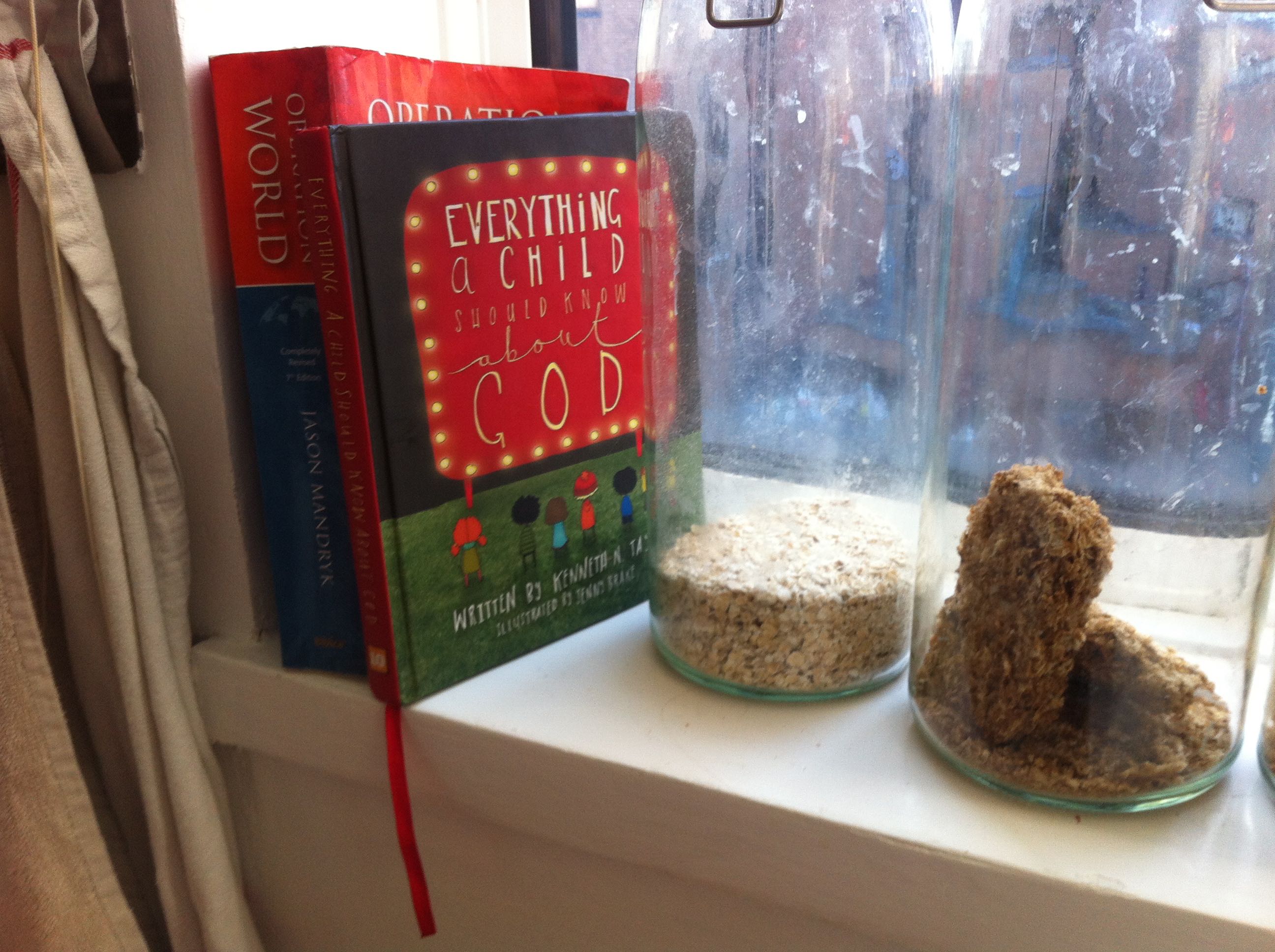
I’ve recommended a children’s book for you over at Good Reads if you’d like to take a look.  Here is a picture of it on my kitchen windowsill, next to the porridge oats.  Incidentally, my sister-in-law believes that decanting your cereal into jars is the litmus test of being a super-organised mum.  However, in my case it’s the sign of not having enough cupboard space for cereal boxes.  But I digress.  Hope you find the book review helpful!

Learning to Wait

I want you2


Have you ever left your child somewhere? I expect so.

I don’t mean in a Home Alone way (although is it just me or can you see how that easily happens?); no, I mean have you left them with a relative, or at nursery, school, crèche that sort of thing? It can be hard the first few times (or more), especially if they run after you with tears streaming down their cheeks. But then they learn an important lesson – that mummy does come back later. My youngest recently learnt this lesson, and now I can leave him in a crèche once a week without any tears. I guess that’s an important life skill for a child, because most children do need to be able to cope when mum or dad aren’t there.

And so they learn to wait. I don’t mean to sit with their coats on for an hour, longing for me to return (which I think my daughter did for a while when she first started nursery), but to get on with their ‘work’ (play), knowing that I’ll come back for them. They can feel secure where they are, because they know it’s not forever. Sometimes my daughter writes me notes (like the one shown above), saying “Mummy I really want you right now,” when something has upset her at school. I hate finding them! But she’s usually over it by the time she sees me, and I hope that when she’s upset, it’s a comfort to know I will come back at the usual time.

I’ve written before about learning lessons from my children (Learning to say ‘Thank You’), and I’ve been thinking lately that they can also teach me how to wait.

My middle child, Ezra, has latched onto one of God’s promises in particular – the promise that Jesus will come back and get us. If you’re a Colin Buchanan fan, you’ll know these verses well:

“Do not let your hearts be troubled. You believe in God; believe also in me. My Father’s house has many rooms; if that were not so, would I have told you that I am going there to prepare a place for you? And if I go and prepare a place for you, I will come back and take you to be with me that you also may be where I am. You know the way to the place where I am going.” John 14:1-4.

Jesus promises his followers that he has gone to prepare a place for us, and he will come back one day and take us there. My son has accepted this seemingly without a problem. ‘Oh, he’s coming back to get us’ he nonchalantly reminded me one day in the car. And I realised then, that I’m not as reassured by this promise as my 3-year-old son is. Perhaps this is because he is used to waiting for someone to come back and get him. And perhaps because, being a child, he has a child-like trust in God’s promises that I lack.

And what difference does that make?

If I believe Jesus is coming back to get me, surely I will have greater peace; joy; perseverance; a sense of urgency in preaching the gospel; motivation to be holy.

And when things are really tough, and not just when I’m tired or lonely or discouraged, but when I’m faced with heartbreaking loss or gut-wrenching pain or long-term frustration, I will pray ‘Come, Lord Jesus,’ rather than growing resentful and forgetting that God can see the bigger picture.

And of course this is a flawed illustration, because wonderfully we do have Jesus with us by his Spirit every day. I’m not with my children in spirit when they’re at school, no matter how much I think about them. But the Counsellor, the one who comes alongside us, is doing just that every day:

And I will ask the Father, and he will give you another advocate to help you and be with you forever – the Spirit of truth. John 14:16-17

One of the ways the Spirit helps us is by reminding us of the promise that Jesus will come back soon, and then he will bring us into his perfect Kingdom. Then we will have the answers to all of our questions, and we probably won’t even want to ask them anymore.

Last week I heard a talk on these verses, and it reminded me that I need to be more like my boy Ezra, trusting that Jesus is coming back to get us:

Praise be to the God and Father of our Lord Jesus Christ! In his great mercy he has given us new birth into a living hope through the resurrection of Jesus Christ from the dead, and into an inheritance that can never perish, spoil or fade. This inheritance is kept in heaven for you, who through faith are shielded by God’s power until the coming of the salvation that is ready to be revealed in the last time.  1 Peter 1:3-5

Jesus, I really want you right now.