I’ve been reminded of this lately, particularly when negotiating with my son regarding the number of plums it’s sensible to consume in one day. (You can rely on him to be harbouring a plum stone in his mouth most of the time.) I wanted to write a post tonight (not about plums or stones), but family had other plans. So I hope you enjoy this instead.
I’ve been watching The Good Wife – sorry to disappoint. If you’re blissfully ignorant, it’s a glamorous drama set in a Chicago law firm in which impossibly attractive people betray each other.
There’s a phrase that comes up a lot in the courtroom scenes: “Asked and answered.” It’s an objection which the lawyers use if their opposition is trying to emphasise a point by asking a question that’s already been answered, like this:
Lawyer 1: “Who was with you in the car?”
Witness: “The accused.”
Lawyer 1: “So the accused was with you in the car?”
Lawyer 2: “Objection, Your Honour! Asked and answered.”
Judge: “Sustained.”
I said to Mike the other day that this “Asked and answered” objection is a phrase I’d quite like to use about a dozen times a day with my 5-year-old daughter. Conversations with her tend to…
Hello there. You probably already know about this but it would be rude of me not to mention that you can now buy the live album, See him Face to Face, by the co-mission music bods. (Co-mission is a network of churches in London.) There are 13 songs on there, two of which were written by my gifted husband. For about the first 12 weeks of Martha’s life, Mike was also working at editing these songs. Why such bad timing? Only the Lord knows. But one day I shall see him face to face and can ask him. Of course I won’t care by then. I can hardly remember it now.
What was I saying?
Oh yes. I highly recommend, but of course I’m biased so you should listen for yourself. It’s on Spotify (although… adverts 👎🏼), or you can buy it here.
Sorry for the lack of picture. We don’t have our copy yet…
The Mahaney family are experts at writing short, readable and practical books that pack a punch. I recommend True Beautyto you, which despite fulfilling all the Mahaney criteria took me four months to read (well, just over two years if you count from when I blogged that I was going to read it.) But hey, I had a baby.
I don’t really need to take what I learnt and package into a parenting article because there is actually an appendix in the book in which they apply the lessons to parenting. So please do read the book. However, here are some thoughts from me. I’m afraid they’re a bit jumbled up, for which I partly blame the school holidays.
I don’t know about you but the issue of beauty seems to me like a bit of a minefield. I don’t want my daughter to be vain, but I want her to know that she is beautiful. And is it alright to tell my son he is handsome? And how can I encourage the boys to value true beauty and not just long lashes and Disney manes?
We’re so bombarded with the world’s idea of beauty, however ugly that may be in God’s sight, that it’s tempting to avoid the topic of “beauty” altogether. But if I do that, then my children will only have the world teaching them what is beautiful. And if I try to shield them completely from that, they will either think that all beauty is wicked or they’ll crave worldly beauty like a child craves refined sugar. I don’t want my daughter to spend all of her (potential) pocket money on lip gloss and teen fashion magazines because I never even let her have a mirror in her room. So, how do I navigate all of this without anything blowing up in my face?
What I know in my head if not always in my heart is that true beauty comes from the Lord, because he is the Beautiful One, the source of all beauty and creator of everything beautiful. He defines beauty, and he is right. (You should have been there when I tried to explain this – although not in those words – to my hairdresser… awkward!)
As with all of the good things in this world, beauty has become warped and corrupted so that our own view of beauty is spoilt. But beauty is a good thing, from God, so rather than avoiding beauty we need to celebrate it. We will spend eternity gazing upon the beauty of the Lord, so it must be worth thinking about now!
I really think my children are likely to pick up on and inherit my own attitude on this issue. If I say “Beauty is on the inside” but don’t walk the talk, they won’t buy it. If my husband tells me I look lovely and I say “No I don’t,” and if the only compliments I ever give people are about how they look, and if I spend huge amounts of time and money on my own appearance, then that’s a pretty powerful message to my children.
I think it would really help if I did promote true beauty in the way that I spoke to the children and acted in day-to-day life, rather than just focusing on the false versions of beauty we see every day. I can point out when someone does something beautiful; I can admire true beauty in others. I can talk to my children when we come across examples of worldly beauty which I don’t think the Lord would value, such as saucer-eyed ice princesses having tantrums to music (“the cold never bothered me anyway”). But I can explain those things in a measured way, rather than just banning all things Frozen or Barbie – unless I really want to.
Comic aside:
Ezra: “What’s Barbie?”
Miriam: “It’s a doll, like Hannah got for Christmas.”
Ezra: “Ha ha, Sweeney Todd’s a barber.”
You can’t argue with that.
The Lord’s version of beauty is so much more wonderful and liberating than the world’s. In the world, beauty fades with age. But in God’s kingdom, the beautiful person is wise, generous, hospitable, gentle, hardworking, and joyful. We can grow in these things, so in the church we can look to the older men and women and admire their beauty, and aspire to be truly beautiful. And when we seek to be truly beautiful, we are seeking God’s glory, instead of seeking attention for ourselves, which is vanity. How wonderful it would be if I could bring up my children to enjoy the beauty of the Lord, and so reflect his beauty to those around them.
Smudged but still beautiful
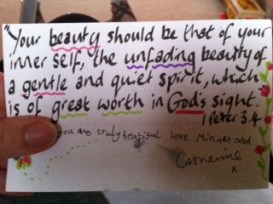
On a practical note, one way that my 6 year old daughter and I recently went on a “true beauty hunt” (I think that’s a quote from the book!) was to make postcards with Bible verses about beauty on them*, and then send them to some of the beautiful women we know. This was a lovely thing to do because we enjoyed making the postcards look pretty(!), talking about the Bible verses and thinking about the women we were sending them to. It encouraged the women who received them, but at the same time taught my daughter how to identify true beauty. I’m praying for more ideas; please let me know if you have any!
*Such as Proverbs 31 v10 or v30; Romans 10v15.
If you have a comment, please click on the speech bubble at the top right corner of the blog post. Please share on social media if you found this helpful, thanks!
I first posted this over 2 years ago, and have finally gotten round to reading “True Beauty” which I mentioned at the bottom. Such, such slowness! But anyway, let’s not dwell on that (please!) – here’s a reminder of it before I let you know how I got on with the Mahaneys…
In our small group recently we were talking about idols of our culture – the things people around us live for. We split into groups of three and chose an idol per group to discuss. One group chose beauty, and they then shared their thoughts with the group. They talked about how the idol of beauty promises respect and acceptance, and how it requires your absolute devotion, and of course that it never delivers on its promises. It might be a surprise to you that it was three men who chose to discuss the idol of beauty. Not once did they refer to, or seemingly think about, the ways in which women seek after beauty. They were looking at the issue from a man’s perspective, and thinking about the men they knew who were slaves to the false god of skin-deep, body-building perfection.
The day after I wrote “True” I found this masterpiece, written by my 5 year old son.
It’s the latest in a string of wonderfully misspelled creations by the comedy genius that is Ezra – his “ants go marching two by two” had me in stitches, I tell ya.
I don’t know if you’re familiar with the Colin Buchanan song God Rock, but it’s about standing firm on the Lord, our rock. The words to the chorus are, “God Rock, get on board the God rock; unbreakable, unshakeable, God Rock.” So while I’ve been hearing Ezra singing along to this and thinking how nice it is that he’s learning all about how God is our rock and all other ground is sinking sand, etc., well he actually hasn’t.
When I wrote before that some children are more spongey than others, I was thinking of Ezra. He has an incredible ability to learn song lyrics. The other day he taught me the order of the minor prophets without blinking. I have Randall Goodgame to thank for that. But clearly even Ezra mishears the words sometimes. And, like everyone else in the world, when he wasn’t sure he just guessed. (Many of us then Google it but he’s thankfully not old enough to Google things yet.) So this is just a reminder to all of us that it’s good to check every now and again that our children actually understand what they’re singing. Especially when so often things are metaphorical. I can feel myself going into another long post about this so will stop myself.
I just need to say, though, that we can’t do this every time. A friend of mine with 3 under 4’s said to me one day that she’d love to teach her children the Bible more, but some days all she has the energy to do is to stick on a CD of Christian music. She clearly felt that this was a failure on her part. I looked at her and thought, ‘what a fantastic woman you are.’ If in your less wonderful moments all you can do is put on a Christian CD, then praise God. I’m not saying that we all need to have a comprehension test after each song. But just to have it on our radars that the children will sing along regardless of whether they have a clue what they’re singing. Even if they get the words right, they might not know what “rejoice” “dwell” or “redeemer” actually mean… (signing off now, despite desperate desire to keep going!).
It would amuse me greatly if you could comment and let me know any funny mistakes your children (or you) have made with Christian song lyrics.
A weird thing happened to me yesterday – two different people got in touch with me to ask me to recommend Christian books for babies. That’s never happened before, and it got me thinking. It’s worth asking people for recommendations on children’s Christian books and music, because let’s face facts – there is quite a range available. And by range, I mean some stuff is spot on, and some stuff is ambiguous, and some stuff isn’t good.
Does it matter? Let’s take music to start with. I grew up in a family where we learnt the words to (secular) songs, and I find it impossible to consider a song without thinking about the words (I’ve since learnt that this is not universal). I’ve spent hours trying to figure out lyrics, listening with headphones (my mum was best at this) – and by the way hasn’t Google just taken the fun out of all of that? But I digress. So, I was raised to think that lyrics do matter. Now I am married to a worship leader who chooses songs for our church to sing, and who also writes songs (in his spare time, ha ha ha ha HA!). So he also thinks that song words matter. If we’re singing to God to praise him and to encourage each other, shouldn’t we be singing stuff that’s true? And by true I mean true.
So let’s honour our children by remembering it matters what they listen to and sing along to. Children are sponges (some more than others, as I’ve discovered), and will quickly learn the words to songs even if they have no concept of what they mean. So we should really be explaining things to them for a start, and also making sure we’re teaching them good stuff – dare I say it, sound doctrine.
Not quite ready for some music!
Here are two examples. I don’t want to point fingers but I think it’s helpful to use examples. Both of these songs are written by people who have written some great stuff, so I’m not saying anything about them as people, but I have comments about these specific songs. Firstly, one from Hillsong kids:
It’s not a secret,
It’s not fairytale,
It’s not made up, Jonah was in the whale, For three whole days, 123!
The greatest treasure, The word God’s people wrote, It’s in the bible, Where Noah built a boat, And it rained and rained,
The rainbow’s in the sky, To show God’s promises are true, The rainbow’s in the sky to show the world, He’s the only way, For your everyday.
OK. Firstly, Jonah has very little to do with Noah or rainbows. Why put him in the song? It’s confusing.
Secondly, the rainbow is in the sky to remind us that God will remember his promise not to flood the whole earth again, which is quite specific: 13 I have set my rainbow in the clouds, and it will be the sign of the covenant between me and the earth. 14 Whenever I bring clouds over the earth and the rainbow appears in the clouds, 15 I will remember my covenant between me and you and all living creatures of every kind. Never again will the waters become a flood to destroy all life. Genesis 9.
I suppose it does remind us that God’s faithful to that promise (and other promises), but I find the chorus a bit ambiguous. I’m not pinning all of my hopes on God because of a rainbow, but rather because of the resurrection.
And thirdly, “he’s the only way, for your everyday” (not sure if you mean every day or everyday, but that’s a different issue*) – Jesus is the only way to the Father. That’s a wonderful promise. I feel like “for your every day” is quite a vague (and disappointing) ending to this sentence. But OK, the song is about the rainbow (not John 14:6**), however the rainbow doesn’t really show me that God is the only way… does it? If it does I can’t see how, and not sure my children will figure it out either.
So all in all, I wouldn’t ban my kids from listening to this but I would want to talk to them about it, and to be honest I would just put something else on which is clearer and doesn’t mix up Bible stories. And again, Hillsong have written many good songs and I’m grateful to them and to God for that. Please don’t take this as an attack on them.
My other example is shorter. There’s a great CD called “Mr Cow” by Julia Plaut which has many good songs on it. However, the ten commandments one has the refrain “these ten rules are all you need” (in fact, that’s the name of the song). Well… if you mean they’re all you need except for the fact you can’t keep them and therefore you’re desperately lost and need a saviour, then yes I agree. But since my children are naturally legalistic (being human and all), I don’t want to affirm that by letting them think that ten rules are all they need. In contrast, Randall Goodgame’s Ten Commandments song is spot on:
“The ten commandments, no-one can keep them all,
The ten commandments, not even on our best behaviour…
The ten commandments, that’s why we need a saviour.” (from Sing the Bible 2).
I’d rather my children learnt this truth than that they actually learnt the ten commandments (which they will also do, from the song.)
So I hope I’m helping you to see that it really does matter what we teach our kids through music. Maybe this was obvious already? But when I’ve said stuff like this to friends they sometimes haven’t even thought about the words, so I hope it was worth mentioning.
Well I haven’t even got onto books yet. Perhaps we should make this a two parter….
(To be continued)
*Don’t get me started on everyday and every day! But I genuinely don’t know which they mean and that’s not their fault – I don’t have the official lyrics.
**Incidentally, if you want a good song about John 14:6 then Colin Buchanan’s is great (hoo cha hoo cha hoo cha cha). Does anyone know a good one about rainbows?
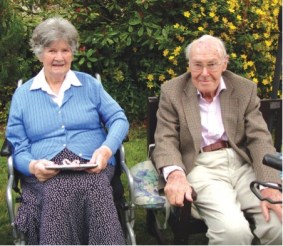
Amazingly, until December last year my husband had all four of his Grandparents still living. But his Nana went to be with Jesus in December, and in April her husband followed her. Gramps was almost 98 when he died, so while it was sad to say goodbye to him, we were able to celebrate his long and very interesting life together at a thanksgiving service in May. Aren’t people’s lives amazing? We found out that Gramps survived a direct hit on his flat during the Second World War, in which all of his neighbours were killed, and on a much lighter (but still amazing) note, he once had a cactus exhibition in the Chelsea Flower Show. He was an extraordinarily talented man. I wanted to share with you three lessons I learnt that day:
We pass on more than our hair colour
One thing I find fascinating is that while I sat there listening to the story of Gramps’ life, I could tell that my husband takes after him. Mike’s incredible focus and single-mindedness, his love for science and his creativity – all of these have trickled down, in part at least, from Gramps.
It’s worth bearing this in mind. I suppose I don’t have any control over some of the things I pass onto my children, but I can control some of it. Will I pass down a fiery temper, or patience? Will my grandchildren display my gratitude or my grumbling? Yikes. Something to pray about.
Gramps was also a very talented artist, and loved painting landscapes.
God’s creation speaks of his glory
Gramps spent almost his entire life resisting the Lordship of Jesus, but he was so impressed by the beauty of God’s creation that he couldn’t deny the existence of the creator God. He was, rightly, unceasingly amazed by the wonder of this beautiful universe.
I’m not really into plants, or animals for that matter. My children are more likely than I am to point out to me blossom on a tree or the bright moon on the afternoon school run. But I need to train myself to see the beauty in the created world. Since it all points us to the glorious Creator, it’s my duty as a parent to help my children enjoy the world and praise the God who made it all.
The heavens declare the glory of God; the skies proclaim the work of his hands. Psalm 19:1
It’s not too late to turn to Jesus
Gramps lived a life burdened with guilt over things he’d done. Being human, he’d done things to feel guilty about. And he found no relief from this burden until right near the end of his life here on earth. Without Jesus, we all have so much to feel guilty about, don’t we? It’s hard enough as a Christian, knowing I’m forgiven, not to dwell on awful or just downright foolish things I’ve said or done. And if we don’t feel guilty about things, we certainly will on the day we meet Jesus as our judge. That’s unless we’ve found forgiveness from the Father through Jesus the saviour. Gramps found that forgiveness through Jesus, and acceptance from God, right at the end of his life. The truth is, we don’t know when our life will end. So don’t put it off – bow the knee to Jesus today. In this life it’s never too late.
Jesus answered, ‘I am the way and the truth and the life. No one comes to the Father except through me. John 14:6.
‘Come to me, all you who are weary and burdened, and I will give you rest. Take my yoke upon you and learn from me, for I am gentle and humble in heart, and you will find rest for your souls.’ Matthew 11:28-29.
I had a baby. Her name is Martha. Martha Grace Brooks. She arrived on 7th April. (Why Martha?)
What a humbling experience it is to have a newborn baby. You hope you slightly know what you’re doing a bit more with number four, and maybe you do but still not nearly enough. And you also can’t predict what might happen with this specific baby. My baby got mastitis. No, I didn’t know that could happen either. Neither did the Receptionist at A&E. I had to argue my way in!
One day, around week two I think, my 6-year-old daughter asked me this: “Why are babies born as babies? Why aren’t they born, bigger, like one or six or something?”
I think the question behind that question is, “Why does it have to be so bloomin’ hard? So much crying from baby and mum, so little sleep, so many dirty nappies!”
What would you have said? I was caught off guard and in my semi-conscious state said something about it being good for us to be humbled as parents, and also that we don’t always know why God makes things the way he does, but he is wise and we are not. Not the best answer but I think it was at least true, so could have been worse.
But I’ve been thinking about it a bit more, and I suppose there are several reasons why the Lord created us to be babies first. And we know that he glorifies himself in creation: when we look at his world, it shows us what he is like (see for example, Romans 1:18-20). So what can I learn about the Lord from my newborn baby?
Well one thing I have learnt is that in some ways my relationship with my child is a picture of God the Father’s relationship with me, his adopted child. As I look at her in her vulnerable state, relying on me for everything, and really giving nothing back in return (she isn’t even smiling yet), I can remember that I’m in a similar position (although more extreme) before my Heavenly Father:
My heart is not proud, Lord, my eyes are not haughty; I do not concern myself with great matters or things too wonderful for me. But I have calmed and quieted myself, I am like a weaned child with its mother; like a weaned child I am content. Israel, put your hope in the Lord both now and forevermore. (Psalm 131)
As my baby trusts me, I can learn to trust my Father in heaven.
New parents often talk about the extreme emotions they feel for their newborn child, and how surprising it can seem that they are capable of such passionate feelings of love and protection for a little bundle of life. When I feel like that, I can remember that this is just a mere picture of the Lord’s feelings for his people. Look at how he spoke to his people through the prophet Isaiah:
As a mother comforts her child, so will I comfort you; and you will be comforted over Jerusalem.” Isaiah 66:13
The Lord in his mercy is using the picture of motherhood to explain to his people how tender his loving kindness is. And of course, his love is perfect, unlike the selfish, tired and grumpy version I offer to my own children.
I’m sure there are many more wonderful lessons about God which can be seen through nursing a newborn, but I am very tired and can’t go into them right now. If I go on any longer, I am bound to say something heretical by mistake. I also should be doing some housework and/or attending to my two year old, who is instead watching Bing.
So I will leave you once again with the words of that great Australian theologian of our time, Colin Buchanan:
“(One two buckle my shoe)
God loves her children like the chookie loves her chickies,
The mother hen will gather them underneath her wing.”
(See also Matthew 23:37 and Luke 13:34)
Please remember, sharing is caring, and if you’d like to comment please click on the speech bubble at the top.
‘Don’t trust anyone.’ You often hear that in films, and you can be sure that the main character will later be betrayed by someone that they do make the mistake of trusting. The implication of this is that you can’t actually live without trusting people. You might think you’re not a trusting person, but you still trust some people. If your children are at school, you trust their teachers to teach them and not to harm them. You trust the barista in Starbucks not to poison your coffee. And the higher the stakes, the more trustworthy a person needs to be. If you’re jumping out of a plane, you want your pilot and whoever packed your parachute to be trained and qualified!
I’ve put my ultimate trust in one man – not just for my life, but for the lives of my children. That man is the…
We don’t do time-outs with our children. I’m not saying you shouldn’t, just that we don’t.
My husband and I have agreed before that a time-out would be the worst kind of (reasonable) punishment for our six-year-old daughter. She would hate that more than anything. She can’t bear the thought of us being upset with her and not speaking to her. I know this because a) she finds it very hard to be alone, and b) if ever I’m quiet for a ten seconds after she’s done something wrong or annoying (either deliberately or not), she’s already badgering me to check I’m still speaking to her: ‘Mummy, Mummy I’m sorry Mummy!’
I know that a time-out is different from just sulking and not speaking to someone. And we don’t do either of those things with our children. Especially not the latter. Sometimes that’s hard. Like in moments like this:
Sometimes you think being quiet is the best course of action – sometimes it is. But if you’re actually punishing someone with the silent treatment, that’s not OK. The main reason that’s not OK, is that God our Father is not like that with us. As his children, trusting in Christ, we always have the ear of the Father. He always hears us, and always speaks to us. He’s never in a mood with us, he never makes us face the wall. He does, in love, discipline us, yes, but when we come humbly to him, ‘Daddy, Daddy I’m sorry,’ we’re never turned away.
I want my children to know what God is like, so that is one reason I don’t give them the silent treatment. But let me be clear – my children deserve the silent treatment from God, and so do I. I don’t want them to grow up thinking that God is always listening to them because they’re so lovely and good. I don’t want them thinking that God forgives their wrongs because that’s his job. Maybe that’s how you feel. That’s what the world around us tells us most of the time. If you believe that, please look more carefully at the cross of Christ.
You’ve seen pictures of Jesus on the cross – it’s ugly and agonising. But the real torture of the cross was not the physical suffering or the humiliating mockery. The real torture was that the Son cried out to his Father and got no response:
‘My God, my God, why have you forsaken me?’
For the first time in all eternity, the Father hid his face from the Son and didn’t answer. Jesus had been afraid to go to the cross because he knew that this would happen, and he knew that being cut off from the perfect, loving, life-giving God would be unbearable.
The only way for my children to have a perfect relationship with God the Father forever is for them to understand that they deserve no relationship at all.
But Jesus took what they deserve on the cross, standing in their place, so that if they believe in him they will never have to say the words, ‘My God, my God, why have you forsaken me?’ They will never hear Jesus say, ‘Away from me, I never knew you.’ (Matt 7:22) They will never have to spend eternity without him.
“[Jesus] got the Great Silence so we could know that God hears and answers.” (Timothy Keller, Prayer.)
If you don’t believe this – if instead you think that God is kind and good and will accept you, just as you are, then please take the time this Easter to check your facts. Have a read of a gospel, go to a Bible-teaching church and listen, meet up with a Christian friend. God doesn’t just pat you on the head and tell you that your sin doesn’t matter. The truth is much more wonderful, and much more costly (for him) than that.
Easter is a time of fantastic news, of Jesus beating death for us and winning us eternal life with God. I find thinking about the cross hard – I often want to skip Good Friday and move straight onto Easter Sunday. But the cross is really where I see how much God loves me. That he was willing to give his perfect Son the silent treatment I deserve, so that I can be his beloved child forever.
“19 Therefore, brothers and sisters, since we have confidence to enter the Most Holy Place by the blood of Jesus,20 by a new and living way opened for us through the curtain, that is, his body,…22 let us draw near to God with a sincere heart and with the full assurance that faith brings…” from Hebrews 10.
The controversial colouring page pictured above is a copy of a page from the book, ‘The Garden, the Curtain and the Cross‘ published by the Good Book Co., which you can read more about on my Good Reads page.